| Category | Value | Rating |
| Features | 35% |  |
| Usability | 35% |  |
| Sound | N/A | - |
| Documentation & Support | 10% | |
| Price | 20% | |
| OVERALL RATING = 3.4 Stars (out of 4) 3.6 stars or better: Outstanding, WIHO Award 3 stars or better: Worth considering 2 stars or better: Suited to specific needs 1 star or less: Not recommended |
||
Every year at NAMM, we fight our way through crowds of black-clothed guitarists, questionable hair dye decisions, and jeans that appear to violate several laws of physics in search of something genuinely new. New guitar colors and the latest “transparent” overdrive are fine, but they rarely move the needle. Every once in a while, though, we stumble across something that makes us stop and take notice.
This year, Casio surprised us with the new Dimension Shifter. Casio? Yes! Something for guitar? Yes!
What Is It?
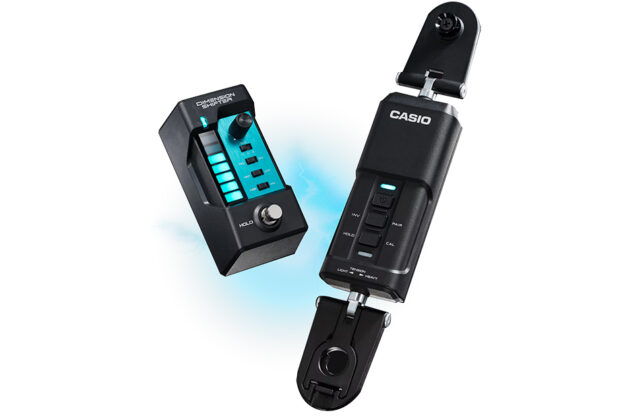
The Dimension Shifter is essentially an expression pedal that you wear and play with your hands and body. Instead of controlling effects with your foot, it mounts between your guitar strap and strap button, allowing you to control expression parameters by moving the guitar itself.
As you raise and lower the guitar's upper horn—or wherever the strap button is located—the spring-loaded transmitter extends and retracts, functioning much like the rocker on a traditional expression pedal. It communicates wirelessly via Bluetooth with a receiver connected to your modeler or effects processor.
Why You Want This
Because sometimes you don't want to be tethered to your pedalboard. The Dimension Shifter lets you control virtually anything an expression pedal can control while moving freely around the stage.
Anything assignable to an expression pedal on your modeler or multi-effects unit is fair game: volume, wah, tremolo speed, chorus depth, pitch effects, and much more.
After spending several months with it, we found it shines in some applications and falls short in others. Think of it as a tool for adding occasional color and dynamics rather than replacing a traditional expression pedal altogether.
For example, you're probably not going to use it to nail the rapid-fire wah section of the “Sweet Child O’ Mine” solo unless you've mastered the rare art of simultaneously playing fast lead guitar and performing interpretive dance. However, for volume swells, occasional wah effects, tremolo adjustments, chorus modulation, and ambient textures, it can add a unique level of expression without ever taking your foot off the floor.
Check out our NAMM demo here, achieved within the first two minutes of experiencing the Dimension Shifter:
Features
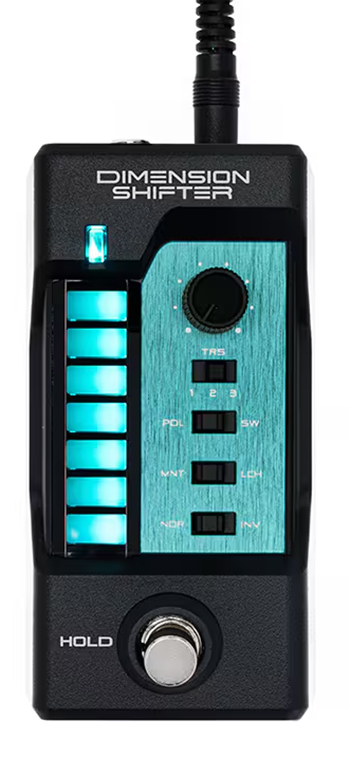
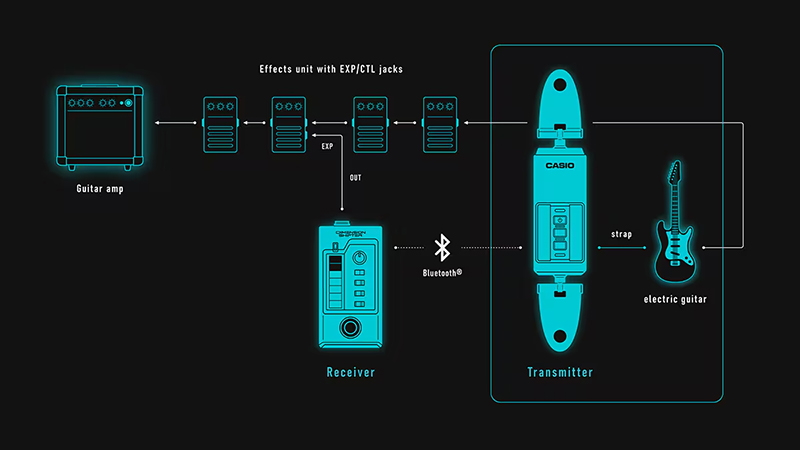
The Casio Dimension Shifter consists of two main components: a transmitter and a receiver.
The receiver plugs into the expression input of your modeler or effects pedal, while the transmitter mounts directly between your guitar strap and strap button. Rather than physically plugging into the guitar, the transmitter uses a built-in spring mechanism that extends and retracts as you move the instrument up and down at the horn of the body or wherever the strap button attaches.
Receiver
The receiver is powered by a 9V adapter and includes several switches that allow it to work with a wide variety of modelers and effects units.
The first is a TRS selector switch with positions labeled 1, 2, and 3. Different manufacturers use different expression pedal wiring schemes, so Casio includes multiple configurations to maximize compatibility. Simply try each position until you find the one that works with your rig.
Next is the Mode switch, which offers two operating modes:
PDL (Pedal) Mode – Functions as a traditional continuous expression pedal.
SW (Switch) Mode – Functions as an external footswitch that can be assigned to tasks such as turning effects on and off, changing presets, or triggering other functions within your modeler.
A second switch determines how the unit behaves:
MNT (Momentary) – The assigned function remains active only while the transmitter is extended. Once released, it returns to its previous state.
LCH (Latch) – The assigned function remains active until triggered again. This is ideal for changing presets or toggling effects.
The receiver also includes a Polarity switch with two positions for standard/reverse operation. For example, if extension normally increases volume, switching to INV will make extension decrease volume instead. This can be useful for quickly changing the behavior of effects without diving into your modeler's menus.
Whether you're controlling volume, tremolo speed, chorus depth, pitch shifting, or something far more experimental, the flexibility is essentially the same as a traditional expression pedal.
Finally, there's the HOLD footswitch.
The HOLD function freezes the current expression value exactly where it is. Imagine dialing in the perfect wah frequency and wanting it to stay there throughout an entire section. Press HOLD, release the transmitter, and the setting remains locked.
The same concept applies to volume levels, tremolo rates, modulation depth, or virtually any parameter you're controlling. It's a surprisingly useful feature that eliminates the need to constantly maintain tension on the transmitter.
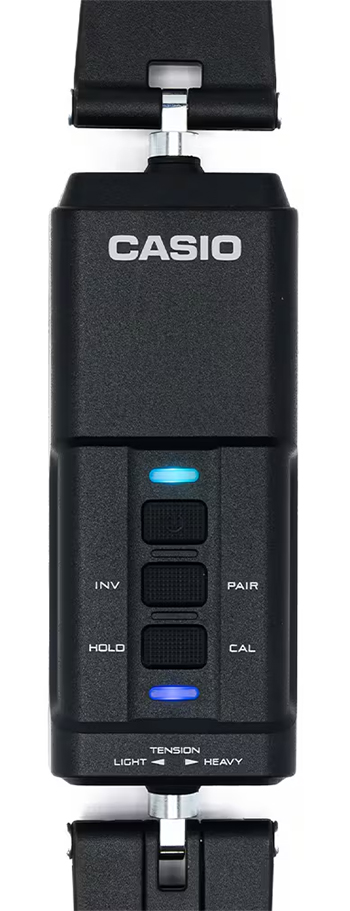 Transmitter
The transmitter includes an adjustable tension control that determines how much force is required to extend it.
This adjustment becomes important depending on the weight of your guitar. A lightweight instrument may require lower tension, while a heavier guitar—say, a 10-pound Les Paul capable of doubling as gym equipment—will likely need more resistance to prevent unintended movement.
The goal is simple: the transmitter should remain at rest until you intentionally move it.
Power comes from two AAA batteries, with an estimated battery life of approximately 20 hours.
A dual-function INV/PAIR button handles Bluetooth pairing and also allows you to reverse polarity directly from the transmitter. This means you can change expression direction on the fly without walking back to the receiver.
Another dual-function HOLD/CAL button manages the HOLD feature and system calibration. Because every guitar weighs differently and every player stands and moves differently, the calibration function allows the internal spring mechanism to be optimized for your specific setup.
Specifications
- The transmitter weighs just 0.33 lbs. (excluding the two AAA batteries) and measures 1.97" wide x 1" deep x 4.72" long.
- The receiver features a ¼" TRS output jack and measures 2.36" wide x 4.53" deep x 1.57" long.
- Wireless communication is handled via Bluetooth 5.1 with an operating range of up to 30 feet. Casio rates latency at approximately 20ms, which proved unnoticeable during our testing.
- The receiver does not include a power supply. Casio recommends using the commercially available AD-0913S adapter, although most standard pedalboard power supplies should work just fine.
Usability
So how do you set this thing up?
Fortunately, it's about as close to plug-and-play as a device like this can be:
- Attach the transmitter between your guitar strap and strap button.
- Connect the receiver to your modeler’s or pedal’s EXP/CTL input using a TRS cable.
- Power up both units and allow them to pair automatically.
That's the easy part.
The bigger question is what you're actually going to use the Dimension Shifter for.
During our testing with a Fender Tone Master Pro, we found the Dimension Shifter worked best when used as an occasional performance tool rather than a full-time replacement for a traditional expression pedal. Volume swells, wah accents, tremolo changes, pitch effects, and ambient textures all felt natural and useful.
Where things become more challenging is when you ask it to perform the duties of a constantly moving expression pedal.
Early on, we had visions of roaming freely around the stage while ripping through the “Sweet Child O’ Mine” solo and working the wah simultaneously. Reality arrived quickly. Coordinating rapid lead playing while rocking the guitar back and forth proved considerably harder than it sounded in our head.
The Dimension Shifter excels when used to add expression and movement at key moments rather than requiring constant, precise control. Think less “traditional wah pedal” and more “soundscape architect.”
Players in the vein of Yvette Young, who frequently incorporate textures and dynamic effects into their music, may find particularly creative uses for it. Players who expect to replace every foot-controlled expression movement with body motion may face a steeper learning curve.
One feature we especially appreciated was the calibration system. Once properly adjusted for the weight of your guitar and your playing position, the Dimension Shifter feels surprisingly natural. After a short adjustment period, using it becomes second nature.
Well... mostly second nature. You still occasionally catch yourself making strange guitar movements that probably look a bit awkward to everyone else on stage. But hey, it’s still cooler than those guys with keytars.
Documentation and Product Support
At the time of this review, documentation and instructional content were somewhat limited. A handful of YouTube videos and a developer interview demonstrate the basic concept, but comprehensive setup guides and real-world usage examples are relatively sparse. Given how different the Dimension Shifter is from a traditional expression pedal, more educational content would certainly help new users get the most out of it.
[Editor’s Note: We have been informed by the team at Casio that more content is coming including a deep dive into the pedal’s use.]For complete specifications and product information, visit the official Casio product page here.
Price
The Casio Dimension Shifter sells for $299.
The recommended power adapter adds another $39 if you don't already have a compatible pedalboard power supply, bringing the total investment to over $350 after taxes in many locations. That puts the unit in an interesting position.
On one hand, it offers functionality that simply doesn't exist in a conventional expression pedal. On the other hand, many players will compare it to a $50 expression pedal and wonder whether the added freedom and novelty justify the additional cost.
Some players will undoubtedly view it as a gimmick. Others will see it as a genuinely innovative performance tool that opens creative possibilities unavailable anywhere else.
The answer largely depends on how often you plan to use expression control away from your pedalboard.
Another factor is visibility. Unlike most guitar gear that discreetly hides on the floor, the Dimension Shifter is mounted directly on the guitar strap and is impossible to miss. Some players won't care. Others may not love wearing on stage what looks like a small science experiment attached to their instrument.
Additional Thoughts
The Casio Dimension Shifter is one of the most genuinely innovative guitar accessories we've seen in years.
It doesn't replace a traditional expression pedal, nor should it. Instead, it creates a new way to interact with effects and modelers that can add movement, dynamics, and stage freedom to your performance. And if you happen to have real mobility issues, or a physical handicap, this pedal can unlock your ability to finally play with expression where you were never previously able to utilize a pedal on the floor.
Its strengths are clear: wireless operation, creative flexibility, simple setup, and the ability to control expression parameters without returning to your pedalboard.
Its weaknesses are equally apparent: a learning curve, limited usefulness for fast and highly precise expression movements, and a price that may be difficult for some players to justify.
Still, we appreciate companies willing to try something different in a market crowded with millions of pedals promising to change your life. And we love that an engineer at legendary keyboard instrument company—Casio—brought his personal pet project to life and was given the green light to make it real product for guitar players.
The Dimension Shifter isn't for everyone. But for players who enjoy experimentation, ambient textures, and finding new ways to interact with their gear, or players who simply can't utilize a floor-based expression pedal, it offers a genuinely unique experience that may be worth the ride. Bravo to Casio for some real guitar innovation!
Contact Information
Casio
www.casio.com