Before Touching A Fader
I regularly work with local and Ontario-based bands in small to medium-scale venue environments, with everything from three-piece bands to eleven-piece groups. Every show is different, but over time I have adapted a workflow that gives me somewhere consistent to start. There is a lot that goes into mixing a live show before I start moving faders.
The important word there is start.
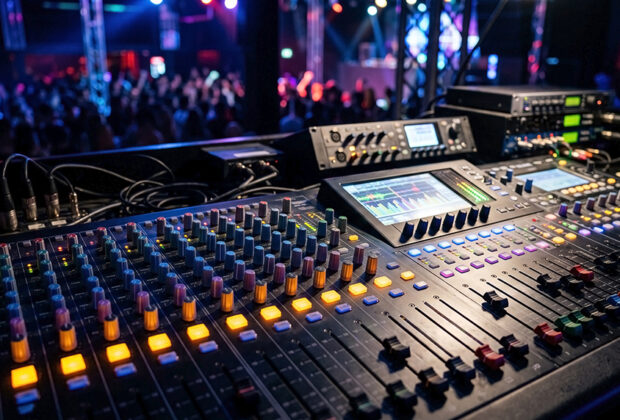
Like many engineers, I have a personal “show-start” scene that I use as a framework. My first eight channels on the mixing board are reserved primarily for drums, followed by bass, several electric guitar channels, acoustic instruments, stereo keys and five general vocal channels. My DCAs are pre-labelled if I need them for the show. My effects are already organized so that when a band walks through the door, I'm not building a console file from nothing.
This scene is a starting place, rather than a prepped show file. Even when I'm working with a band I've mixed before, I may look at where I ended their previous show to remind myself how the different elements sat relative to one another. Then I clear the slate and listen again. The musicians may be playing differently, the audience may change how the room responds, and what worked yesterday may not be what the room needs today.
The preparation gives me somewhere to start. My ears still have to tell me where to go.
Listening To The Room
One of the first things I do when working in an unfamiliar venue is walk around and listen.Every pocket of a room can sound different. Where does the low end build up? Where do the high-mids become particularly noticeable? Are there areas where certain frequencies seem to disappear? What is the room naturally doing before I start trying to change anything?
One room I regularly work in has taught me this particularly well. It is a relatively open space without extensive acoustic treatment and different areas can have noticeably different balances. There are places where low-frequency energy becomes more prominent and others where the mids and upper-mid information cut through very clearly. Physical structures throughout the room also affect the audience’s musical experience. That means I can't assume that what sounds good from one position represents what everyone else is experiencing.
If Front Of House (FOH) is located at a good listening position, I'll work from there. But whenever possible, I walk the room. If I'm working digitally and can control the console remotely, I'll take an iPad with me and make adjustments as I move. If I'm on an analog console, I'll walk, listen, make mental notes, return to FOH and adjust. The audience isn't standing at my console. I need to hear what they're hearing.
The First Input Is The Person
When a band first arrives, I pay attention to the human side before I worry too much about the technical side. How are they arriving? Do they seem stressed? Excited? Agitated? Open? Are they rushing? What does their body language tell me? That information helps me understand how to approach them. I want every artist who steps onto a stage I'm responsible for to understand that I'm going to take care of them, but I'm also going to take care of their art. For musicians who aren't travelling with their own trusted technical team, the house engineer has an enormous amount of influence over their experience.
The last thing I want an artist thinking about while they're performing is: Do I sound good? I don't want them thinking about the technical side at all. I want them immersed in their music and focused on their performance. Once that rapport is established, the technical conversations become much easier.
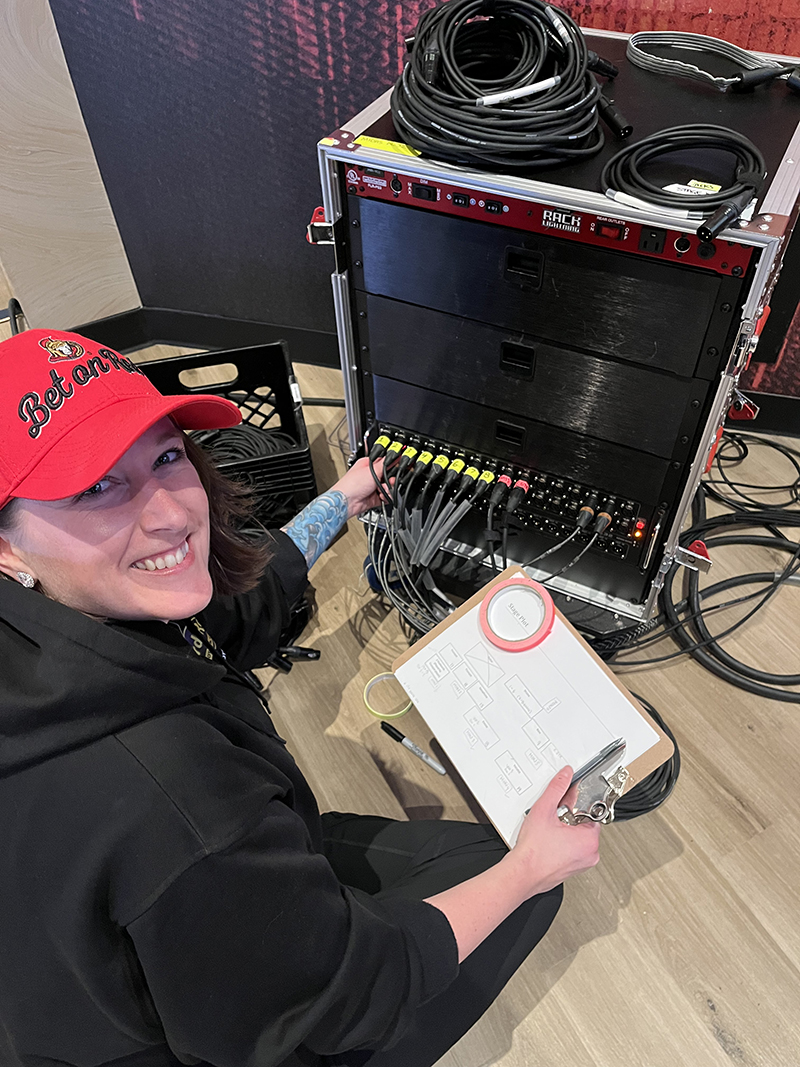
Patching inputs and working through the stage plan before a show.
Soundcheck Is A Conversation
Soundcheck, for me, isn't just a process of checking inputs and setting levels. It's where I start learning how the musicians want to hear themselves and, just as importantly, how they want their music represented to the audience. I can make technical decisions all day, but those decisions need to support what the artist is actually trying to create. That requires conversation. During setup and line check I'll ask about guitar tones, acoustic warmth or presence, vocal effects and monitor preferences. Some musicians tell me, “Do whatever you want.” Others know exactly what they want. Both answers are useful.
Sometimes an artist gives me complete freedom, and sometimes they arrive with a very specific idea of their tone, their monitors or how they want the room to feel. My job is to understand where they're coming from, communicate what I'm hearing, and find the balance between their artistic intention and what is technically achievable in the venue.
It’s Not About Liking The Tone
If a musician has spent months or years developing a particular tone, it isn't my job to decide whether I personally like it. There is a difference between my subjective preference and an objective technical problem.
If a bass player arrives with a very specific sound they have developed, my first job is to understand that sound and translate it through the PA. That's different from a musician who wants me to help shape the tone they're sending me. Learning to recognize that distinction changed the way I work with artists. I don't want to redesign somebody's art simply because I would have made a different artistic choice. Where I step in is when something about the source begins to interfere with the artist's intention. Maybe it's generating feedback, masking something important, creating excessive energy in the room, or otherwise becoming a barrier to the performance. At that point, it isn't about whether I like the tone. It's about helping that tone translate successfully to the audience.
The “Turn Down” Conversation
Stage volume can be a touchy subject. Yes, I ask guitarists to “turn down” (and I don’t mean party). I do it fairly regularly. But how you ask can make your life considerably easier or considerably harder. Sometimes we'll turn an amplifier around. Other times I may put more guitar into the musician's wedge so they can still feel connected to their instrument without requiring as much level directly from the amp. The solution depends on the stage, the musician and what else is happening around them. What I'm trying to preserve is some control over what reaches the audience without taking away what the musician needs to perform.
That conversation becomes much easier when I've already established trust. If the musician knows I'm actively mixing (I'm listening for their solos, following where the melody moves, bringing important elements forward and pulling other things back) they don't have to rely entirely on their amplifier to guarantee they'll be heard.
Stage volume isn't only a mix consideration; it's also part of the total sound exposure experienced by everyone onstage. Sound exposure is cumulative. Both level and duration matter. Under the 3 dB exchange principle used by the National Institute for Occupational Safety and Health, every 3 dB increase in level halves the equivalent exposure time. This is a useful reminder that a seemingly small increase in SPL can represent a meaningful increase in exposure. (NIOSH, 2024)
That's another reason I don't see controlling stage volume as a battle between the engineer and the musician. I'm trying to create enough level for the performers to feel connected to what they're doing without adding energy to the stage simply because we can.
Feedback: Know Where The Edge Is
When I first started working in live sound, feedback terrified me. Part of that fear came from not trusting my ears yet. I remember hearing sustained guitar tones and having that immediate internal reaction: Is that feedback? Where is that coming from? My relationship with feedback is very different now.
There is a respect for it. If I hear something beginning to ring, my brain moves toward investigation rather than panic. Whenever possible, I want to discover where those limits are during soundcheck rather than unexpectedly during the show. But sometimes a musician needs more level in a wedge and I know we're getting closer to the available gain-before-feedback. That's where communication becomes important.
I recently had two vocalists asking for more of themselves in their wedges on an already busy stage. I was happy to continue working toward what they needed, but I also explained that we were getting closer to the point where monitor feedback could become a risk. Late in the show, under different stage conditions, I heard a little ringing. I knew where it was coming from, pulled the monitor level back, and we continued. More importantly, the musicians understood what had happened because we'd already talked about it.
For me, that kind of transparency builds trust. Interestingly, research into uncertainty communication suggests that acknowledging uncertainty doesn't necessarily diminish trust and may actually help protect it when circumstances later change (Dries et al., 2024). While that research isn't specific to live sound, the principle resonates with what I've experienced behind the console: acknowledging a technical risk ahead of time can give an artist context if that risk eventually becomes reality. I'm not promising an artist that nothing technical will ever go wrong during a live show. I'm showing them that I'm paying attention, that I'll communicate when I see a potential problem developing, and that I know how to respond if it happens.
Building The Mix
Sometimes I have the luxury of a longer soundcheck. Sometimes, after line check, I have one or two songs. That means I need a workflow that's efficient without assuming soundcheck is going to solve everything. The real mix continues to develop once the show begins. During the first song, my priorities are pretty straightforward: Can I hear the lead vocal? Can I hear and feel the bass where appropriate? Where is the snare sitting relative to that vocal? Once those relationships are under control, I start listening outward. What's missing? What's competing? Where is the melody moving?
There's an interesting perceptual layer to that priority as well. Research into auditory attention in popular music has found that lead vocals are particularly strong attractors of listener attention, even within complex mixtures of competing instruments (Bürgel et al., 2021). I'm not consciously thinking about psychoacoustics while I'm building that first-song mix, but it makes sense that one of the first things my ears search for is also something the listener's attention is naturally drawn toward.
I'm an active mixer. Those questions don't stop after the first song; I'm thinking about them from the beginning of the show until the end. A mix isn't static because the performance isn't static. Different instruments move forward and backward as the arrangement changes, and I want the mix to follow that movement rather than simply leave every fader where it landed during soundcheck. Eventually, once I'm comfortable with the balance, I've walked the room, and everything is translating properly, I can start having a little more creative fun … AKA: deadly delay throws and enchanting effects! That's one of my favourite parts of the job. There's something magical about sending out a delay, hearing an artist recognize the tail, and lean into it. Moments like these are where an engineer and artist enter into a creative exchange happening in real time.
Modern digital consoles give us an extraordinary amount of processing. On the Midas M32, which is one console I regularly work on, I can handle EQ, dynamics, gating, routing, reverbs, delays and matrix processing without building racks of external processors. But having that processing available doesn't mean I need to use all of it. I prefer restraint. Even across my overall mix, I may use gentle bus compression (around a 1.5:1 ratio with a few decibels of gain reduction) to give the mix a little glue. If I'm making EQ adjustments across the overall mix, they're generally small. I don't want the master bus fixing problems I should have solved somewhere else. The console gives me options, but I still need a reason to use them.
Everything Needs A Pocket
If there is one idea that defines the way I approach EQ, it is that everything needs a pocket. This becomes especially important as the number of musicians increases. If I have ten people on stage and every instrument is fighting for the same frequency range, the result can turn into a jumbled mess very quickly. There is a psychoacoustic basis for some of this. Research into auditory masking and frequency selectivity shows that the presence of one sound can reduce our ability to detect another, particularly depending on the spectral relationship between the target and competing sound (Moore & Glasberg, 1981). For me, creating “pockets” is one practical way of thinking about those competing relationships in a live mix.
Kick and bass are a good example. I don't necessarily want to emphasize exactly the same low-frequency area on both. I might allow the kick to occupy more space around one part of the low end while letting the bass find its weight somewhere slightly different. The exact frequencies aren't the important part. Those will change depending on the kick, bass, musician, room and style of music. What matters is that they can breathe around one another.
I approach multiple electric guitars similarly. If I've got two or three guitars, I don't automatically EQ all three the same way. I'll listen to their roles and tones, slightly offset where necessary, and use both EQ and panning to give them somewhere to live.
Making Space In Stereo
With a larger band, I'll use the stereo field as another way of creating space. Kick, snare and lead vocal generally stay down the centre for me. Horns might sit slightly off centre balanced on opposite sides. Multiple electric guitars can spread farther apart. Toms can move more noticeably across the stereo image.
For true stereo sources such as keyboards, I'll generally maintain the stereo signal and link the channels. On the Midas M32, I keep my stereo sources organized as odd-even channel pairs. The console can be configured to restrict stereo pairing to odd-even channels, so that's something I account for when designing my channel layout before a show. The goal isn't panning for the sake of panning. It's space. I'm also mindful that a live audience isn't sitting in one ideal stereo listening position. Research into stereophonic reproduction shows that perceived imaging can change as listeners move away from the centre or “sweet spot” between loudspeakers (Momose et al., 2015). That makes me more conservative about where I place something essential to the mix. Panning can help create separation, but I don't want an important musical element to work beautifully at FOH and disappear for someone standing off to one side.
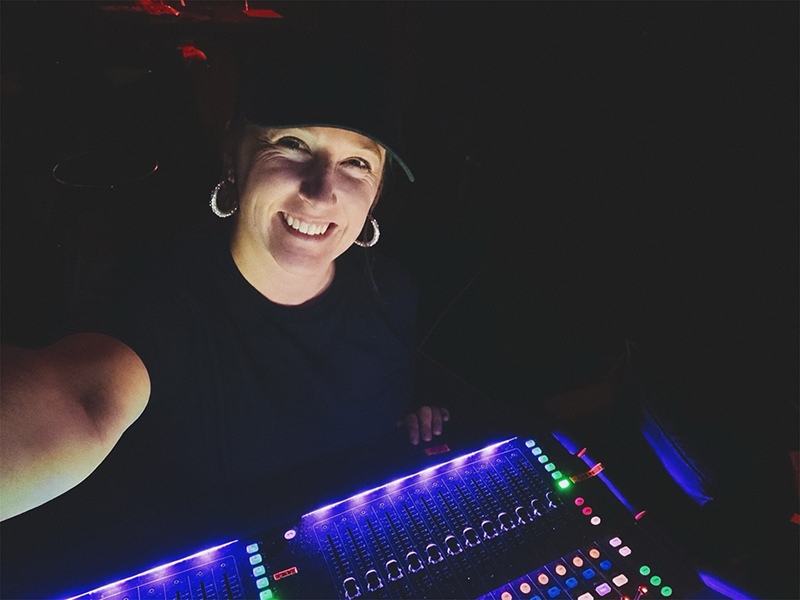
Behind the Avantis console during a live show at the Bronson Centre in Ottawa, Canada.
What’s Missing?
My general EQ mentality is subtractive. Boosting is conservative and highly intentional. That means when something isn't working, my first instinct usually isn't to start adding more energy. High-pass filtering is a good example. I don't follow a rule that says every instrument except kick and bass gets a high-pass filter. In fact, I may high-pass both kick and bass a little as well. What I'm asking is: Does the information “down there” contribute something useful to this source and this mix?
A hi-hat doesn't need the same low-frequency information as an acoustic guitar. A keyboard doesn't automatically need the same filtering every night because the patch can completely change. An acoustic guitar that needs warmth and body may benefit from information I would remove from another source. Context matters more to me than a predetermined number.
The same principle applies when an instrument disappears in a dense mix. Say I'm mixing a country band with acoustic guitar, electric guitar and a tenor lead vocal. If I can't hear the acoustic guitar, it would be very easy to grab that fader and turn it up. Instead, I ask: What don't I hear? And then: What other instrument on stage is competing with that missing component? Maybe I don't actually need more acoustic guitar. Maybe another element needs to come down slightly, or needs a small EQ adjustment, so the acoustic guitar has somewhere to exist. I'm trying to understand the relationship between the sources before automatically adding more level.
Research into multitrack equalization supports the underlying principle: spectral masking can make individual sources more difficult to distinguish, and changing the spectral relationship between competing sources can reduce both measured and perceived masking (Hafezi & Reiss, 2015). And if the problem really is coming from the acoustic guitar itself, that's when I want to work backward. What is the instrument actually sending me? How is it being picked up? Is there something happening at the source that would be better addressed before I make a major correction at the console? Constantly boosting whatever I can't hear becomes a dangerous game. Eventually everything is loud and nothing has space.
EQ By Habit
There are certain frequency areas engineers learn very quickly to watch. Around the low-mids, for example, it can be tempting to start carving simply because we've learned that an area is likely to become muddy. Those instincts and habits are useful. I've developed some through my own experience, and I've inherited others from peers and engineers with considerably more experience than me. What I try to stay mindful of is why I'm making the decision. Am I cutting something because I'm actually hearing a problem, or because I've learned that this is a frequency I'm supposed to cut?
One idea that challenged the way I think about this came from engineer and House of Kush founder Gregory Scott. When dealing with a resonance, Scott recommends experimenting with a cut slightly above or below the exact offending frequency rather than automatically cutting directly at its centre. For broader mud or buildup, he describes shifting the cut farther away—often upward in his own work—to preserve some of the warmth and body surrounding it. His larger point is what stuck with me: sometimes the frequencies bothering us are also contributing to the character of the sound (House of Kush, 2026).
That mentality has made me more conscious of the habits I bring to the console. If I cut the same frequency range from the vocals, guitars, snare and everything else simply because I've learned to watch that area, eventually I've removed that information from practically the entire mix. Something needs to live there. Sometimes a narrow cut is exactly what an instrument needs. Other times I might work around the problematic area rather than immediately notching it out. The decision should come from what I'm hearing, not because my EQ curve is supposed to look a certain way. My preference overall is to amplify the natural character of the musicians and their instruments without processing everything unnecessarily.
Even Effects Need Their Own Pocket
I apply the same thinking to effects. For vocal reverb, I don't necessarily want the effect to return, reproducing everything contained in the dry vocal. I'll filter low-frequency information from the reverb and control the high end, particularly in a room where upper-frequency energy already travels extremely well.
Delay gets treated differently. I'll generally remove considerably more low and low-mid information from my delay while allowing enough presence through the upper mids for repeated words to retain their articulation. I want to hear the lyric repeating. I don't necessarily want all of the low-frequency energy from the original vocal repeating with it. The effect should support the source without fighting it.
There is a perceptual reason to be mindful of how much information an effect is carrying. Reverberation can reduce speech intelligibility and interfere with the perception of consonant information, particularly as reverberant energy overlaps with subsequent speech (Hodoshima et al., 2006). For me, filtering effects returns is one way of keeping the space and character I want without asking the effect to reproduce every part of the original vocal.
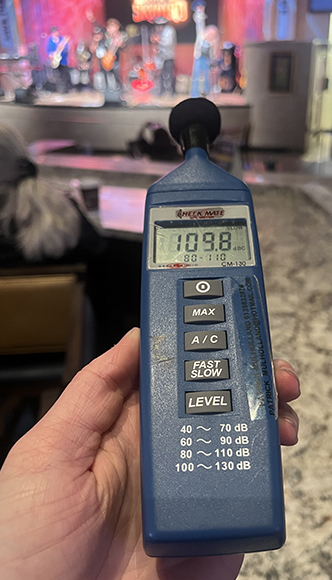
A live sound-level reading at FOH: 109.6 dBC Slow
LOUDNESS
A Good Mix Does Not Equal A Loud Mix
For the shows I'm mixing, I generally like my overall level to sit somewhere around 95–100 dBA Slow, measured from my FOH position, with brief louder moments potentially reaching roughly 101–103 dBA Slow.
But saying a show is “100 dB” doesn't mean much without understanding how that number is being measured. A- and C-weighting apply different frequency-weighting curves to the measurement. A-weighting significantly reduces the contribution of low-frequency energy, while C-weighting retains considerably more of that information. In a live mix with significant kick, bass and sub energy, the two readings can therefore be noticeably different (NTi Audio, n.d.-a).
Time weighting matters too. Fast and Slow measurements respond differently to changes in sound pressure level. Fast uses a 125-millisecond time constant while Slow uses one second, resulting in a steadier displayed measurement (NTi Audio, n.d.-b). That's why I try to know what my meter is actually measuring rather than treating the number on the screen as an absolute description of loudness. But the larger point for me is simple: a good mix does not equal a loud mix.
When I'm initially building a FOH mix, I don't want volume to disguise problems. I'll often pull the subs out initially and begin establishing relationships between kick, bass and lead vocal. I want to hear what the stage itself is already contributing and what actually needs reinforcement. Then I build.
It's something I've carried with me from studio mixing. If I can make the relationships in a mix work without relying on sheer level to make it feel exciting, I have a much better foundation when I bring the system up. It also stops me from automatically trying to overpower the stage. If the acoustic drum kit is already contributing significantly to the room, that's information. If the guitar amplifier is already reaching the audience without much help from me, that's information too. I'm mindful that the PA isn't the only thing making sound.
The Audience Is Another Meter
I watch level, but I also watch people. Are people who are sitting and eating still comfortable sitting there? Can people communicate with the person beside them? Are people moving toward the performance, or are they retreating toward the back of the room? Is someone covering their ears? And, frankly, if several people suddenly start staring at the sound technician, there's probably a reason. Human behaviour gives me information that a meter cannot.
When the audience is engaged and the band is feeling the show, that's where I thrive as an FOH engineer. There is an energy exchange happening between the band, the audience and the person mixing the show. That's one of the reasons FOH is my favourite position.
Small Shows Build Big-Show Habits
There are obvious differences between mixing a three-piece band and an eleven-piece band, but my underlying approach doesn't change very much. What changes dramatically is time and people management. With three musicians, I may have considerably more time to talk individually about tone and monitoring. With eleven musicians, I still want every person to feel taken care of, but I'm fitting far more communication, patching, inputs and monitor requirements into roughly the same production window. That's why I take organization seriously even on smaller shows.
I admit, it can look excessive when there are only three or four people on stage. I don't really care. The habits I build while mixing a three-piece are the same habits I'll need when I'm working with eleven people and hopefully, eventually, on stadium stages and major tours. I don't want to wait until the show becomes complicated to learn how to be organized.
There Is Always More to Learn
I’m intentionally building habits for the stages I hope to work on someday, but bigger stages won’t mean I’ve somehow figured all of this out. There will always be another room to understand, another artist who challenges how I think about sound and another engineer whose approach makes me reconsider my own. Maybe that’s what I love most about live audio. It sits somewhere between math and science, emotion and human experience, technology and art. I can study acoustics, understand my equipment and train my ears, but none of those things exist independently from the people making and experiencing the music.
So I want to keep listening. I want to work in unfamiliar rooms, join teams that challenge me and learn from people who approach this work differently than I do. I’m not sure there is a point where you finish learning how to mix live sound. The rooms change, the technology changes, the musicians change. Oh, and we change too.