
 If you’re like us, your hardware keyboard collection keeps growing (as it should). And if you’re a really cool keyboard player who has more keyboards than you can logically justify to non-musicians, then you’ve undoubtedly run into the limitations of typical keyboard stands that only hold two or three keyboards apiece. As keyboard players, we have long enjoyed the ubiquitous A-frame stands in our studios to help with our ever-expanding collections, but Jaspers, a German company founded in 1985, has a line of stands that will really help to consolidate the keyboard space in your room. Easy to assemble, sturdy, lots of optional accessories, and taking up a smaller footprint than expected, anyone with too many synths should really check their stands out.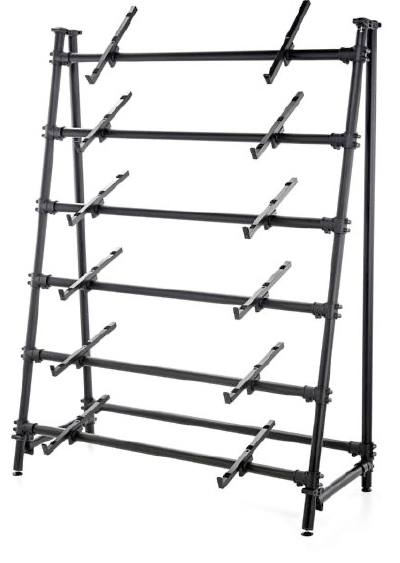
We have long heard about Jasper’s popularity in Europe, but without American distribution, we weren’t sure what to think. But at the 2025 NAMM Show, we had a chance to finally check out the Jaspers hardware and came away with a great first impression. While they don’t yet have a domestic distributor, you can easily purchase their products through Thomann, one of the largest music equipment retailers in the UK and Europe (their version of Sweetwater, from an American perspective). We’ve purchased many products from Thomann safely from the US, and given the quality of their customer service and reliability, this opens the door for many more of you to get your hands on these great products.
| Category | Value | Rating |
| Features | 35% |  |
| Usability | 35% |  |
| Sound | na | na |
| Documentation & Support | 10% |  |
| Price | 20% |  |
| OVERALL RATING = 3.8 Stars, which earns it a WIHO Award! 3.6 stars or better: Outstanding, WIHO Award 3 stars or better: Worth considering 2 stars or better: Suited to specific needs 1 star or less: Not recommended |
||
Since we have a number of keyboards we wanted to organize better, we opted for an awesome six-tier stand: the Jaspers 6D-120B. The nomenclature tells you about the stand itself: the “6” tells you the number of tiers, the “120” tells you the width in cm, and the “B” tells you the color (black in our case, or an “S” for silver). Interestingly, Jaspers is willing to make custom size lengths, and we took advantage of that. We had a specific space we wanted to fit our stand into in the studio, and we were concerned about the full 120 cm width fitting. The next smallest standard width, 105 cm, wouldn’t fit all of the classic 61-key keyboards we had in mind (you know who you are, Korg M1!). So we ordered a custom size shrinking the 120 cm model to 110 cm, which is a free service that barely impacted delivery time! Kudos to Jaspers for that.
We received a box that was relatively long, given that the stand is 170 cm tall. The tubes are strong but lightweight, made from aluminum, with no sharp edges. The keyboard tiers and support tier towards the base are connected by locking clamps made of reinforced plastic, similar to the collars used to set up drum racks.
If you’re concerned about the numbers, each tier can hold 15 kg (33 pounds). However, if you need more weight on a given tier, fear not! You can purchase a “strengthening tier” for €40 (roughly $46 USD), which then enables your tier to hold 40 kg (88 pounds). While that’s not quite enough to hold a Rhodes Piano or Yamaha CS-80, that should be plenty for most keyboards and classic synths.
We mentioned previously the height of the 6D-120B was170 cm. The width is 130 cm end to end, with the inner width 120 cm, (120 cm and 110 cm respectively in our customized version), and depth is 52 cm. Of particular importance, all tiers are height adjustable and inclinable. The holders themselves are 40 cm front to back.
Interestingly, while the 40 cm holders are the holders that come standard, you can order additional holders of varying depths, from 16 cm to 70 cm. For our purposes, holding various keyboards from 1985 to the present, we thought the 40 cm version was fine, and we ordered an extra pair to hold multiple smaller keyboards on one tier, like a MicroKorg. Though we didn’t have any on hand to review, other accessories/attachments include monitor holders, a boom arm (for microphones), music stand, laptop stand, LCD TFT adapter, iPad/tablet adapter, and even a keyboard and mouse swivel plate! The standard 40 cm holders, in black, look like so:

Getting back to when we first opened the box, there was a card that explained how to put things together. Although a bit on the minimalist side, there’s not really much to say either. You basically lie one of the frame sides down on the floor (although the card also says you can use a table), put the 6 aluminum tiers and additional base stabilizing tier in and make sure the plastic connectors lock in place, and then tighten the hex nuts with the provided Allen wrench. You then place the other side frame onto the tiers, doing the same thing with locking the plastic connectors in place and tightening the hex nuts with the Allen wrench. It’s all pretty straightforward, but we found that a couple of the preinstalled plastic connectors were not on exactly perpendicular, so the tiers would be at off angles to the connectors on the other side. This was an easy fix, though. Just loosen the connector and adjust, and then tighten up again. The other thing to keep in mind is that the holders themselves need to be oriented in such a way that the hole (see above photo) is towards the back of the stand. We did not realize this at first, and halfway through assembling noticed that we now had to disassemble to flip over the tier in the correct orientation. As they say, RTFM!

Once assembled, we had our moment of truth: putting the stand in the spot we hoped it would fit into. Fearing the worst, we hadn’t tightened the hex nuts completely, just in case we had to disassemble. Worrying was all for nothing, as it fit perfectly in the space we allocated—and we were definitely wise to make it 110 cm instead 120 cm, as it had to fit between our mixing desk and another multi-tier stand of (yes!) keyboards.
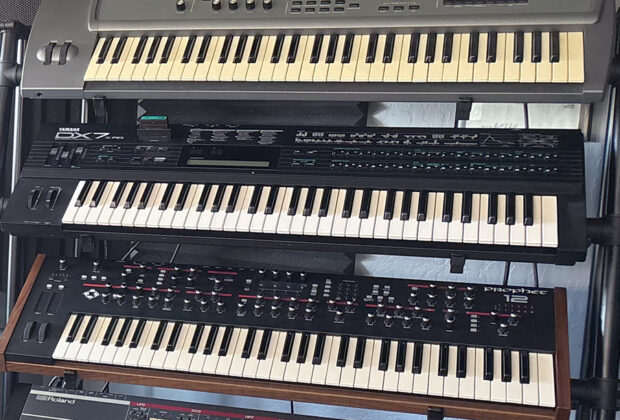
 One thing we were pleasantly surprised about was the smaller overall footprint, particularly the depth. We admit, we are old enough to remember using A-frame tubular keyboard stands prior to Apex stands, and while they worked well, they were bulkier and had a deeper footprint. This is not so with the Jasper stand, as it has a straight back, and only the front is on a slant, creating a smaller footprint. Even better, due to both the angle and shape of the stand itself, as well as the ability to angle/adjust the holders, each keyboard was much more accessible and usable than on our previous stand because the keybed and controls above it were accessible and easy to see. After we got four of the six tiers filled with keyboards, and came to those conclusions, we then asked ourselves, “Why did we wait so long to do this?!?” You can see what it looks like fully loaded in the accompanying photo.
The 6D-120B keyboard stands sells for 443€ ($512.34 USD) which includes19% VAT, but unfortunately does not include shipping costs, which to the US can be a bit pricey with the current state of tariffs. Interestingly, Thomann, the European distributor that also ships to the US, has it listed for sale at a very nice price of $385 USD.
Having said that, this is not a two or three tier keyboard stand. This holds six! And, it does this very well. And it looks great! There’s a lot of additional accessories available as well, and there are multiple widths and numbers of tiers you can choose from, potentially reducing your costs if your needs are less. We love this stand and are already thinking about another one to hold multiple 88-key keyboards. You should definitely check these out, especially after discovering how easy it is to order them even here in the USA.
Jaspers
www.Jaspers-alu.de