| Category | Value | Rating |
| Features | 20% |  |
| Usability | 25% |  |
| Sound | 25% |  |
| Documentation & Support | 10% | |
| Price | 20% | |
| OVERALL RATING = 3.7 Stars, which earns it a WIHO Award! 3.6 stars or better: Outstanding, WIHO Award 3 stars or better: Worth considering 2 stars or better: Suited to specific needs 1 star or less: Not recommended |
||

Last year, we reviewed the fantastic Ivory 3 German D, which you can read about at this link. Given that Synthogy has been in the virtual piano plug-in market for nearly 20 years, it is no surprise that they continue to deliver exciting new and updated pianos such as this latest model, the American Concert D.
The piano itself is a based upon a 1951 New York Steinway D, and was recorded in Quebec, at the same studio the German D Steinway was recorded in. Muc
h of the plug-in interface is the same as the German D. In fact, once the library is installed and you launch the plug-in, if you own the German D already, you will see both pianos in your library to choose from.
Speaking of installation, let’s get the requirements out of the way since Ivory has always demanded significant computer power to experience its most evolved sounds.
- 8-Core 3.4 GHz Intel Core i7, AMD equivalent, or Apple Silicon recommended minimum. Some features can be adjusted or turned off to accommodate slower hardware or demanding projects
- 16 GB RAM minimum, 32 GB RAM recommended
- At least 38 GB of free hard drive space

- Solid State Drive (SSD)
Our Different PC studio workstation (Intel i9 8-core) and a MacBook Pro (M3 Max) ran Ivory, but while the M3 didn’t struggle at all, we did find (initially) our 8-core i9 did. There were spikes of CPU usage at 100%. We then did a round of updates, to both our Pro Tools version and to the latest version of Ivory 3 itself (as of this writing, 3.0.6.1). This helped the drop-outs and CPU usage issues quite a bit, and then when we lowered the voice count below 60, the problem went away altogether. Again, none of this was an issue on our newer M3 Max Mac.
Installation was easy. You first download a small program that automates the subsequent process of downloading and installing the 38GB library.
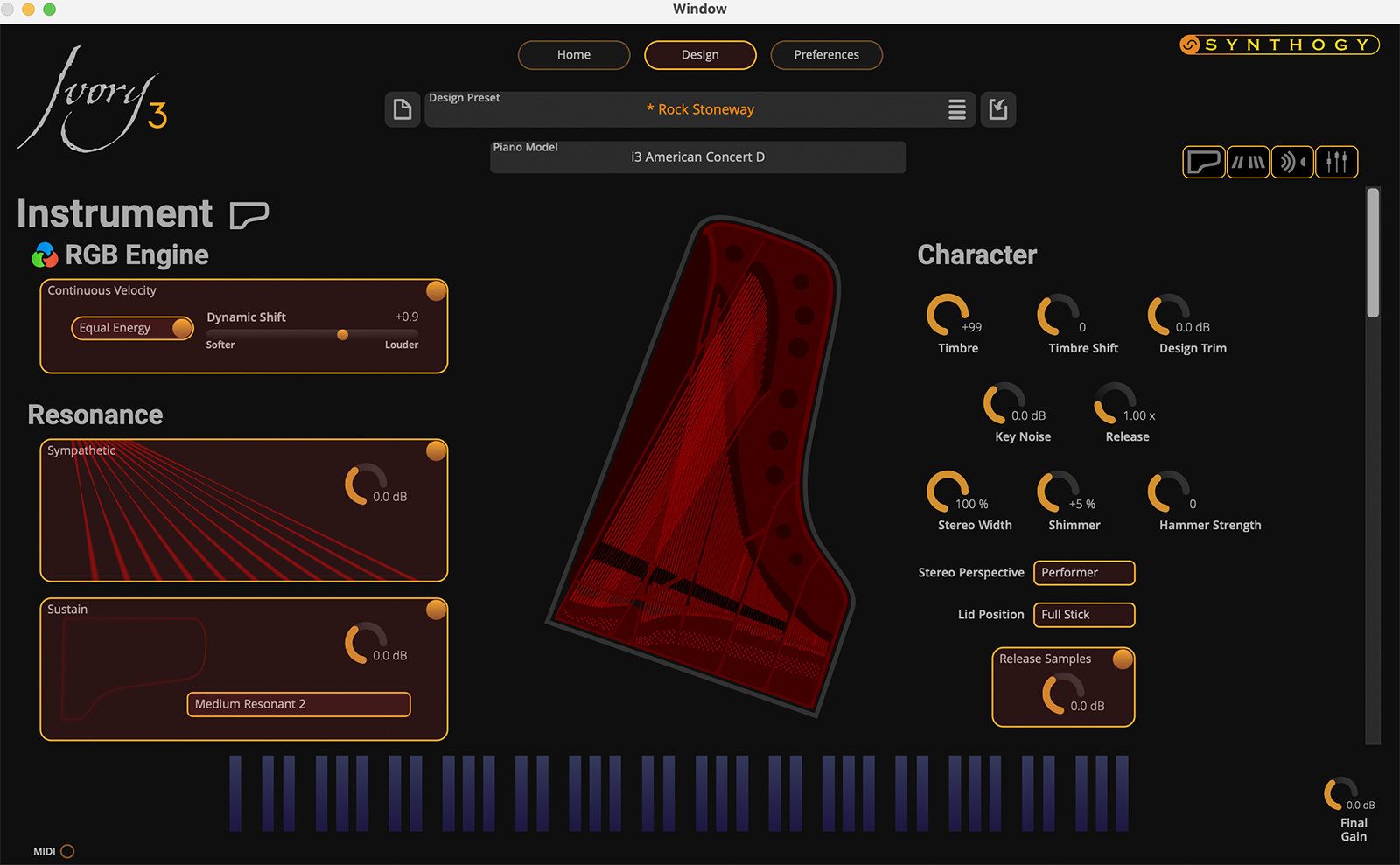
Besides utilizing all-new samples, Ivory 3 is utilizing a new technology called RGB (Realtime Gradient Blending), which creates a smooth gradation of timbre in response to velocity, without any obvious sample switching. According to Synthogy, the RGB engine makes possible the integration of modeling technology with the sound of real-world recorded acoustic instruments. To quote Synthogy about RGB:
“Principle among these features is Ivory 3’s Continuous Velocity to Timbre. Gone are the limitations of velocity layers or levels. Continuous Velocity provides real-time velocity to timbre change at every attack velocity. Whether your controller is sending 127 values of MIDI 1.0 velocity, 16,384 values with MIDI (CC88) Velocity Extension, or 65,536 values of velocity with MIDI 2.0 16 bit Hi-Resolution velocity, Ivory 3’s Continuous Velocity feature provides endlessly smooth velocity to timbre change for each value sent.”
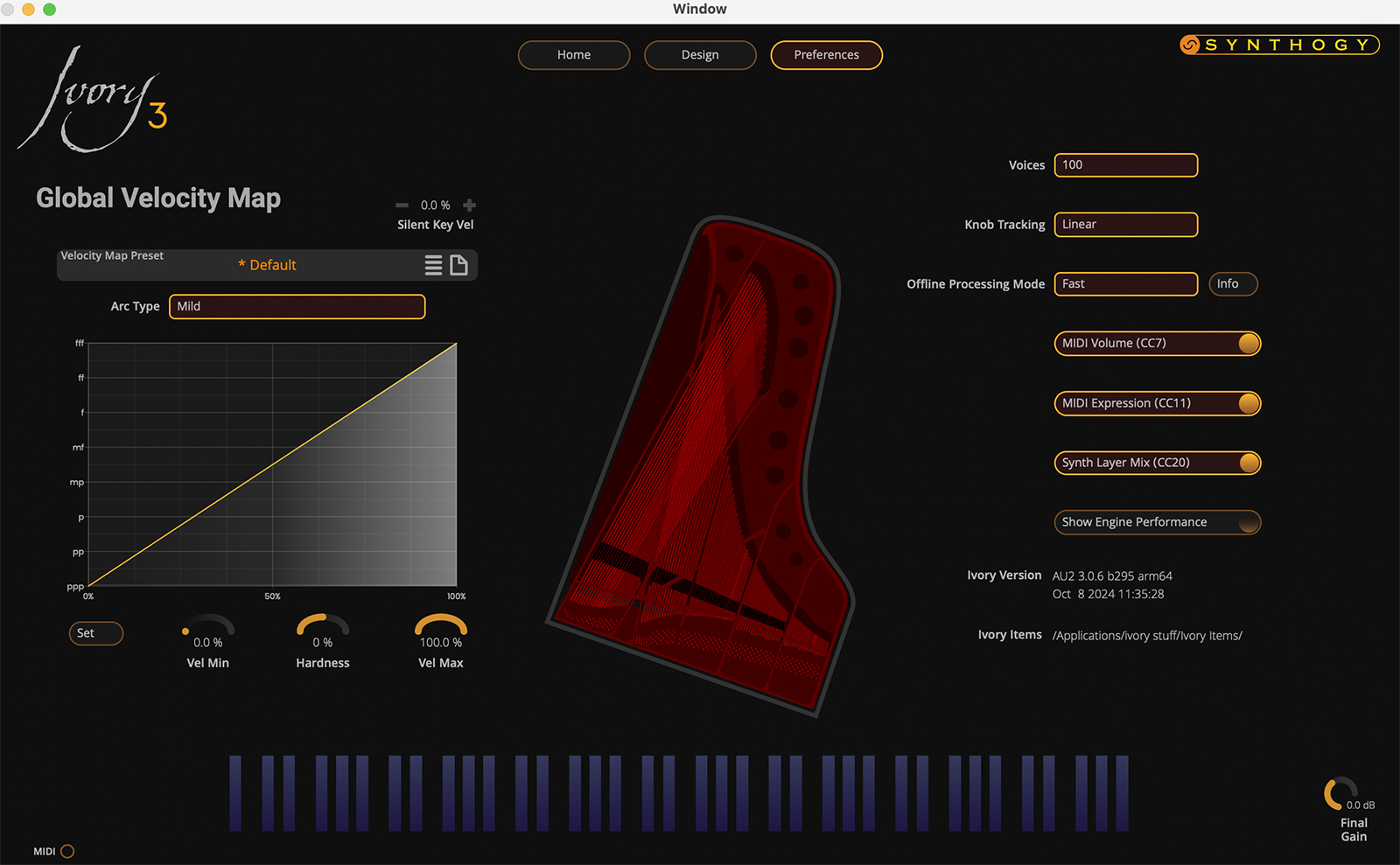
As this is the Ivory 3 engine, like the previously reviewed German D, you have four stereo microphone positions and an on-board mixer to allow control over the sound. Each Stereo Channel in Ivory 3's Mix Desk has its own Trim, Gain, Polarity invert, 3-band EQ, Compression, Ambience, Chorus/Delay, Balance, M/S processing, bus sends, and multiple signal paths (if desired). Like German D, you also get a synth layer section, which we were pleasantly surprised about when we checked it out in the prior review.
Finally, Ivory 3 supports full backwards compatibility with Ivory 2, which is fantastic for those of us who have been doing this for a while and have our go-to presets from earlier versions! For a more in-depth discussion about the Ivory 3 engine, please see our Ivory 3 German D review.
How does the American Concert D sound? To our ears, great! This reviewer grew up learning to play on 100-years old Steinways. The sound of aged Steinways was darker and fuller than a newer piano, and American Steinway D captures that, as it is a piano from 1951 (74 years old). We particularly liked the low-end rumble and bite of the lower bass keys, which we felt were a little more pronounced than the German D offering. The presets of American Concert D and German D are different, but a nice touch is that either piano can use the other’s preset (essentially allowing you to choose either piano if you have both libraries).
 Ivory 3 American Concert D sells for $249 USD as an initial purchase, or for $139 as an upgrade from Ivory 2. This is somewhere in the middle, asthere are both more and less expensive options. However, the piano sounds great, and has that older, darker Steinway sound that many players (like this reviewer) happen to prefer. When only the sound of a Steinway will suffice, and you’re looking for a virtual solution, Synthogy’s Ivory delivers no-compromise sound if your computer has the specs to run it.
Contact Information
Synthogy
www.synthogy.com