In the age of streaming, catalog gold rushes, and AI music sludge, the record business has quietly changed its job description.
For most of the modern music business, the central mythology of the record label was discovery. Somewhere, in a club, a rehearsal room, a college town, a church basement, a smoky bar, a MySpace page, a SoundCloud link, an A&R person heard something before the rest of the world did. The artist was raw. The songs were promising. The image was unfinished. The audience was small or nonexistent. Then the machine went to work.
The label found the producer. The producer found the sound. Marketing found the story. Radio found the single. Press found the angle. Retail found the display. Touring found the opening slot. The public found the artist.
That was the old romance: artists were discovered, developed, and launched.
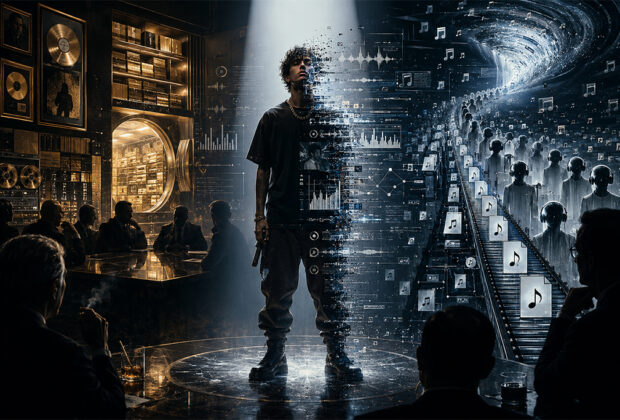
The new reality is colder, faster, and more efficient. Today, artists are not so much made as collected. They arrive at the label already formed, or at least sufficiently formed to be quantified: with an audience, an identity, a data trail, a visual language, a content rhythm, a cultural community, a viral song, a touring signal, a TikTok footprint, a Spotify curve, a fan vocabulary, a look, a point of view, and enough proof that someone in a corporate office can justify the check.
The artist is no longer the raw material. The artist is the asset.
The label does not create the phenomenon. It waits for the phenomenon to become legible, then tries to buy it, amplify it, partner with it, distribute it, or control it. The process is not entirely new, of course. The music business has always chased heat. But the balance has changed. The industry’s appetite for risk has shrunk just as the supply of music has become effectively infinite. In the age of AI-generated tracks, algorithmic playlists, synthetic vocals, fake bands, content farms, and eleven million artists all shouting into the same feed, the business no longer wants mystery. It wants evidence.
That is the defining shift in the contemporary music business.
The chart is getting (much) harder to enter
A recent study of 65 years of Billboard Hot 100 history gives statistical shape to what many artists, managers, and label people have felt for years: the chart is no longer moving the way it used to. The researchers found that chart behavior has changed dramatically, especially over the last 15 years. Top-ranked songs now stay on the chart much longer. Lower-ranked songs churn faster. The bottom of the chart is more chaotic, but the top is more entrenched. Fewer new artists make it in, while established hitmakers occupy more positions.
That combination is brutal for developing artists. The top of the market has become sticky. Once a song breaks, it does not leave quickly. Streaming allows hits to linger indefinitely because the listener does not have to make a new purchase decision. The song simply remains available, playlisted, algorithmically reinforced, socially referenced, passively replayed, and nostalgically reactivated. A hit is no longer a burst. It is a weather system.
At the same time, the lower part of the chart has become more disposable. Songs enter, flicker, and vanish. Viral momentum may create a spike, but not necessarily a career. The artist may appear on the chart, but that does not mean the audience has committed. The industry sees the signal, tests the signal, and often moves on. A song can now be huge for a week without the artist becoming meaningful for a year.
This is the paradox of the streaming era: there are more artists than ever, more songs than ever, more ways to be heard than ever, and yet fewer clear pathways to becoming a mass-culture artist. Discovery has exploded. Breakthrough has bottlenecked.
The denominator has become absurd
The old music business had scarcity built into the system. Studio time was expensive. Manufacturing was expensive. Distribution was controlled. Radio access was limited. Retail space was finite. Media gates were real. The number of artists who could even enter the professional arena was small compared with today.
Now the gates are gone, but so is the map.
Chartmetric reported more than 11 million artists in its system in 2024, with roughly 1.7 million added in that year alone. That is not a talent pool. That is an ocean. And now the ocean is being fed by AI systems that can generate competent background music, fake nostalgia, synthetic pop gestures, anonymous lo-fi, ambient wallpaper, and almost-songs at industrial scale. What used to be a flood of human ambition is becoming a flood of human ambition mixed with machine output, prompt farms, royalty hacks, and endless sonic filler designed less to move people than to occupy space.
This is often described as democratization, and in one sense it is. Anyone can release music. Anyone can upload. Anyone can build a page, post a video, distribute a single, pitch a playlist, run ads, sell direct, and reach listeners around the world. But democratized access is not the same as democratized attention. The door is open. The room is packed. The lights are off. Everyone is talking at once.
The market has opened at the bottom and hardened at the top. The result is a strange two-tier reality: more artists can now build small or mid-sized careers, but fewer artists become obvious, consensus stars. More people can participate. Fewer can dominate. The middle class of music may be wider than before, but the superstar class is harder to enter.
That is why labels have become more conservative, not less. The infinite supply of artists has not made A&R more adventurous. It has made A&R more dependent on proof. When there are millions of artists and millions more tracks arriving behind them, taste alone starts to look inefficient. Data becomes the flashlight. Metrics become the alibi. The question is no longer simply whether the artist is great. The question is whether the market has already made greatness financially defensible.

Labels want evidence now
In the old model, A&R was partly taste, partly instinct, partly politics, partly gambling. The label took a risk before the market had fully spoken. In the new model, the market speaks first.
A&R does not disappear, but its function changes. The modern A&R person is less like a scout wandering into the unknown and more like an analyst watching the radar. The question is no longer simply, “Is this artist great?” The question is, “Is there already evidence that people care?”
The evidence can take many forms: a TikTok sound that refuses to die, a song with high save rates, a YouTube video that spreads without paid media, a touring market that overperforms the artist’s streaming rank, a fan community with language and rituals, a regional genre movement breaking through global platforms, a sync or social moment that sends listeners backward into the catalog, or a direct-to-fan audience that behaves more like a congregation than a casual following.
The artist has to arrive with proof of life.
This is why so many recent breakthroughs do not look like traditional label inventions. Olivia Rodrigo came with a Disney audience and an emotionally explosive song that became a social narrative. Zach Bryan came with raw Navy-era videos, an anti-machine authenticity, and a direct fan connection. Peso Pluma came out of a regional Mexican wave that streaming had made global. Chappell Roan arrived as a fully realized world — queer, theatrical, communal, visual, funny, defiant — after being dropped by a major label. Benson Boone arrived through TikTok, television exposure, a celebrity mentor, and a giant vocal identity.
These artists were not blank slates. They were already legible worlds. The label did not invent the world. The label recognized that the world had become valuable.
The new artist is already a company
This is the part many musicians do not want to hear: the modern artist is expected to do a shocking amount of pre-label labor. Before anyone meaningfully invests, the artist is often expected to have figured out the music, the visuals, the audience, the short-form content, the release rhythm, the brand architecture, the emotional proposition, the live show, the fan relationship, and the story.
In the past, some of that was the label’s job. Now much of it is the artist’s audition.
The artist must be creative director, content strategist, community manager, data interpreter, performer, songwriter, editor, entrepreneur, public character, and sometimes unpaid advertising department. The music still matters, but the music alone is rarely considered enough. In a market where everyone has access to the same platforms and increasingly the same AI tools, “good” is not the rare commodity. Attention is. Belief is. Distinction is. The ability to make strangers organize their emotional lives around your work is.
This is why the phrase “artist development” has become almost misleading. Development still exists, but it often begins after the artist has already developed themselves. The label may refine, scale, fund, connect, and exploit. But the seed stage has been outsourced to the artist.
The modern label wants a self-starting cultural object. It wants an artist who has already made people gather.
In my own work with Artist Expansion, I see this tension up close. The artists who come through the door are not asking to be “discovered” in the old sense. Many already have records, catalogs, audiences, visual identities, social habits, mailing lists, touring histories, sync ambitions, and deeply personal reasons for continuing. What they need is not someone to manufacture them. They need help understanding what they have already built, what it means, where it can go, and how to make the next move without losing the center of the work.
That distinction matters. Artist development used to imply that the artist was incomplete until the industry finished them. But the more useful idea now may be artist expansion: not making an artist into something else, but helping the artist become more strategically, commercially, and emotionally legible as themselves.
Catalog changed the risk equation
At the same time, the industry has discovered that old music is not old anymore.
Catalog used to be the back room of the business: reliable, valuable, but not necessarily glamorous. In the streaming era, catalog has become frontline competition. Old songs live beside new songs on the same platforms, in the same playlists, in the same feeds, available at the same instant. A 20-year-old song can behave like a current single if TikTok revives it. A 40-year-old song can re-enter culture through a film, a television show, a meme, a dance, a documentary, a death, a tour, or pure nostalgia. A classic album is no longer a static artifact. It is a living revenue stream.
This changes the capital allocation problem. New artists are expensive. They require time, staff, marketing, content, tour support, radio or playlist strategy, publicity, creative development, and repeated failure. Even when they work, they may take years to break. Even when they break, they may not last. Even when they last, the economics may be diluted by short attention cycles, high costs, complex deals, and endless competition.
Catalog, by contrast, is proven. It has known songs, known audiences, known data, known sync potential, known nostalgia triggers, and increasingly predictable streaming behavior. It may be expensive to buy, but it is easier to underwrite.
This is why the optics of the current industry are so revealing: companies cut staff while raising or deploying enormous sums for catalog. Warner Music Group, for example, announced major cost-saving initiatives and headcount reductions while also launching a joint venture with Bain Capital to invest up to $1.2 billion in iconic music catalogs. That juxtaposition says almost everything. The business still needs new stars, but it increasingly rewards ownership of old ones.
In the age of AI music, catalog becomes even more valuable because it represents something machines cannot easily fake: historical attachment. A synthetic track can imitate mood. It can imitate genre. It can imitate polish. It can imitate the vague contour of emotion. What it cannot manufacture, at least not honestly, is the accumulated memory of a song people have lived with for decades. Catalog is not merely music. It is proof that a piece of music has already survived culture.
That is why the catalog gold rush is not just nostalgia. It is risk management.

A&R has become acquisition
This is the central point: A&R has not vanished. It has been financialized.
The old A&R question was: Can we help make this artist important?
The new A&R question is: Has the market already made this artist important enough for us to participate?
That is a profound philosophical shift. The label used to be a factory. Now it is more like a portfolio manager. It looks for assets at different stages of maturity: catalog assets, viral assets, regional assets, creator assets, distribution assets, superstar assets, niche assets, and undervalued assets with upside. In that world, a new artist is just one kind of asset — and often the riskiest one.
A catalog song has already survived the market. A new artist has not. A classic recording has decades of emotional proof. A new single has a few weeks of data. A heritage artist may generate predictable income. A developing artist may generate only expense.
So the label’s instinct changes. It becomes less patient, less romantic, less developmental, more responsive to existing heat, more interested in optionality, and more likely to sign after the audience forms, not before. This is why so many artists feel that the industry wants them to do the impossible: build the audience alone, then give away a piece of the upside once the hardest part is done.
They are not wrong.
The modern deal often arrives after the most difficult transaction has already occurred: the conversion of indifference into belief. Once an artist has made strangers care, the industry appears with paperwork, expertise, capital, and a very serious expression. It calls this partnership. Sometimes it is. Sometimes it is a tollbooth.
The five recent breakthroughs prove the rule
The biggest new artists of the last five years did not emerge from one old-fashioned discovery pipeline. They emerged from different worlds that had already begun generating audience energy.
Olivia Rodrigo had the Disney ecosystem, but her real breakthrough was the perfect collision of song, story, fandom, and TikTok. “drivers license” was not merely a single. It was a public emotional event. The audience did not just stream it. They investigated it, narrated it, argued about it, personalized it, and turned it into a generational heartbreak object.
Zach Bryan came from the opposite direction: rough, direct, anti-gloss, and fan-first. His early appeal was inseparable from the feeling that he had not been manufactured. His audience formed around the belief that they had found something true before the machine could polish it. By the time the industry fully embraced him, the bond had already been created.
Peso Pluma broke because he was the face of a larger cultural surge. Regional Mexican music did not need permission from the old U.S. pop system. Streaming globalized it. YouTube amplified it. Young listeners claimed it. The audience was not waiting for mainstream validation; mainstream validation had to catch up to the audience.
Chappell Roan may be the clearest example of the new rule. She had been signed. She had been dropped. The system failed to see the final version. Then she built a world so vivid that the world itself became the selling point: drag, camp, queer joy, Midwestern melodrama, audience participation, theatrical visuals, and songs that felt like both pop records and community rituals. The label did not make Chappell Roan. Chappell Roan became undeniable.
Benson Boone represents another version of the same pattern: TikTok visibility, television exposure, a major mentor, and a voice built for big emotional moments. By the time the machinery scaled him, the raw signal was already there.
Five different artists. Five different routes. Same underlying truth: the audience came first, and the industry came second.
Is the only way in to already be in?
So where does that leave the artist standing outside the gates?
Is the only way into the modern music business to become a successful independent artist first? Must an artist now build the audience, prove the concept, establish the brand, create the content, generate the data, sell the tickets, activate the fanbase, and only then be deemed worthy of development? And if that is true, what exactly is the label developing?
The songs? The audience? The business? The mythology? Or merely the upside?
This is the uncomfortable question at the center of the new artist economy. If a label waits until the artist has already become valuable, is that still discovery? If the audience arrives before the A&R department, is that still artist development? If the artist has already done the hardest and most mysterious part — making strangers care — what is the label’s role now?
Maybe the label is still essential. Maybe not always. Maybe the answer depends entirely on what kind of artist, what kind of music, what kind of ambition, what kind of audience, and what kind of deal is on the table. For some artists, a label can still be the difference between momentum and scale. A label can provide capital, radio promotion, global marketing, playlist relationships, sync reach, tour support, publicity, brand partnerships, international coordination, and the professional machinery required to turn a promising fire into a worldwide campaign.
But for other artists, the label may arrive after the essential bond has already been formed. In that case, the question becomes more complicated. Does the artist need a label, or does the label need the artist? Is the deal a ladder, a megaphone, a bank loan, a distribution agreement, a prestige badge, an acquisition, or a tax on momentum?
And what if the artist does not want to become massive? What if the goal is not global domination but a durable career? What if 10,000 true fans, a direct relationship, ownership of masters, a strong publishing position, a touring base, a subscription community, sync income, teaching, patronage, merch, catalog depth, and low overhead are worth more than a major-label swing at cultural ubiquity?
What if the old dream was not always freedom? What if independence is not always limitation?
The modern artist now faces a strange double truth. It has never been easier to release music, and never harder to be heard. It has never been easier to keep ownership, and never harder to create scale. It has never been easier to build a niche, and never harder to become a consensus star.
So do artists need labels? Maybe the better question is: need them for what? To be heard? To be famous? To be funded? To be validated? To reach radio? To reach the world? To survive? To matter?
A label can still be powerful. But power is not the same as necessity. A label can still open doors. But not every door leads to freedom. A label can still accelerate a career. But acceleration is only useful if the artist knows where the career is going.
Is A&R dead, or did it just move?
And what about A&R? Is A&R dead, or has it simply moved?
Maybe A&R no longer happens only inside record companies. Maybe it happens in the comments section, in the algorithm, in the live room, in the fan edit, in the playlist, in the manager’s inbox, in the Discord server, in the regional scene, in the sync placement, in the small venue where everyone knows the words before anyone in the industry knows the name.
Maybe A&R has been outsourced to the audience. Maybe the audience is now the first A&R department and the label is the second.
That does not mean human taste has vanished. It does not mean great A&R people are irrelevant. It does not mean development is impossible. There are still people inside the business who hear what others miss, who protect artists from bad instincts, who connect writers and producers, who understand sequencing, image, timing, repertoire, audience, and the slow formation of identity.
But are they given the time to do that work? Are they rewarded for patience? Are they allowed to be wrong before they are right? Can a modern label still afford the unfinished artist, or has the unfinished artist become too expensive for a business increasingly built around data, margins, catalog, and proven momentum?
Perhaps development is not dead. Perhaps it has become privatized. The artist develops alone. The producer develops the sound. The manager develops the plan. The fanbase develops the language. The internet develops the signal. The live show develops the belief. The label, if it comes, develops the scale.
That may be the new sequence. Not discovery, then development, then audience. Audience, then leverage, then deal. Not “we believe in you.” More often: “prove that they already do.”
And maybe that is the real change. The old music business asked artists to be promising. The new music business asks them to be undeniable.
But how does an artist become undeniable without support? How many great artists are lost because they are not natural marketers? How much important music never reaches the surface because it does not immediately produce the right metrics? How many slow-burning voices are dismissed because they do not behave like fast-moving content? How much art is shaped not by vision, but by the pressure to prove traction before anyone invests?
These questions do not have simple answers, which is inconvenient for an industry that prefers dashboards. Maybe some artists still need labels desperately. Maybe some artists should avoid them entirely. Maybe some need distribution but not ownership. Maybe some need capital but not control. Maybe some need a team, not a label. Maybe some need time more than money. Maybe some need protection from the very machine they are trying to enter. Maybe some need the machine at exactly the right moment.
The point is not that labels are dead. They are not. The point is not that A&R is dead. It is not. The point is not that development is dead. Artists are developing everywhere, all the time. The point is that the location of development has changed. The risk has moved. The labor has moved. The proof has moved.
The artist is now expected to arrive not as a question, but as an answer.
The end of the unfinished artist
This is what has disappeared: the unfinished artist as a mainstream label priority.
There are exceptions, of course. Labels still sign early. They still develop. They still take chances. Some A&R executives remain deeply musical, patient, and visionary. But structurally, the incentives have changed. An unfinished artist is expensive. A fully formed artist is financeable.
That does not mean the fully formed artist is better. In fact, the old system sometimes allowed strange, difficult, half-formed artists to evolve under protection. It could give them time to fail privately, change direction, find collaborators, make a wrong album, discover a voice, and grow into themselves. The new system often demands that the artist arrive already optimized.
That can produce clarity. It can also kill mystery.
If every artist must show traction before investment, then the system privileges the kinds of artists who can create public momentum without help. That favors the charismatic, the visually fluent, the socially native, the emotionally extreme, the meme-able, the already-networked, the unusually resilient, and the artists whose genre communities are already mobilized.
It may disadvantage artists who are brilliant but slow-forming, private, older, less visual, less socially fluent, less algorithmically legible, or simply not built to turn their lives into daily content. In the age of AI music saturation, that disadvantage may become even sharper. When the platforms are drowning in synthetic competence, the artist is pressured to prove not only that the music is good, but that the person behind it is commercially legible, visually available, narratively useful, and endlessly present.
The tragedy is not that great artists cannot emerge. They can and do. The tragedy is that the industry increasingly waits until they have done the developmental work themselves.
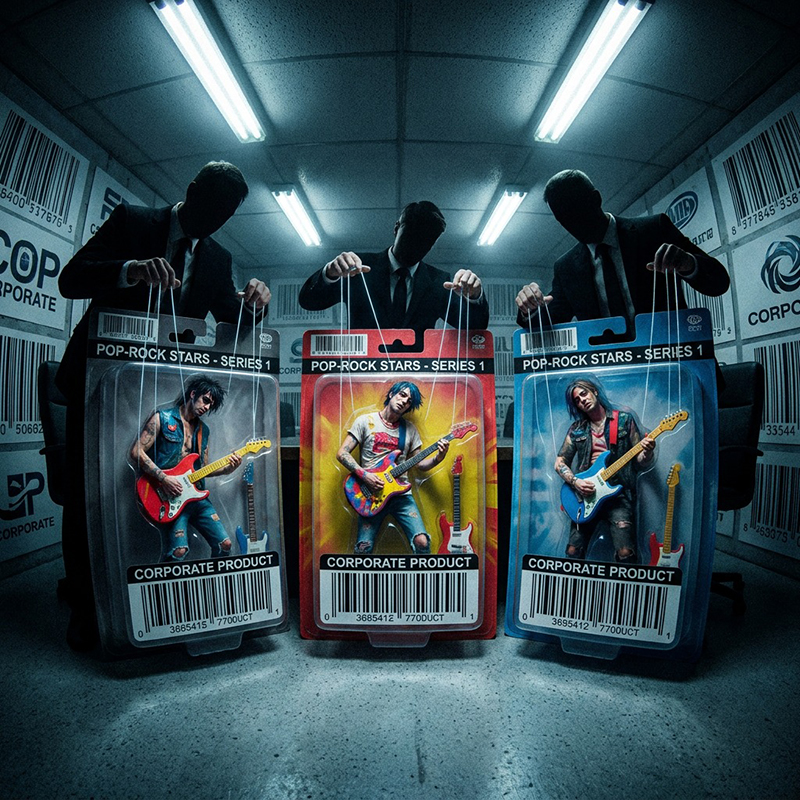
The artist as collectible
There is a reason the word “collected” feels right.
The industry now collects proven things: proven catalogs, proven songs, proven audiences, proven creators, proven fan behaviors, proven regional movements, proven viral signals, proven cultural identities. The label’s dream is not necessarily to discover an artist in the wilderness. The dream is to find an artist who has already built a small civilization — then attach capital to it.
That is not inherently evil. Capital can help. A label can still add enormous value: global marketing, radio promotion, DSP relationships, sync, publicity, tour support, brand partnerships, international strategy, creative resources, and the kind of coordination that most artists cannot build alone.
But we should be honest about the sequence. The label is no longer always the architect. Often, it is the developer that arrives after the neighborhood is already cool.
For artists, the lesson is not to reject labels. The lesson is to understand what labels now buy. They buy momentum, clarity, audience behavior, story, identity, and proof that strangers care. The artist’s job, before the industry arrives, is not merely to make good music. It is to make the music mean something to a specific group of people. It is to create a world that listeners can enter, recognize, share, and defend.
That world does not have to be huge at first. In fact, it probably should not be. Most durable artist movements begin with intensity before scale. The goal is not to be vaguely liked by everyone. The goal is to be deeply necessary to someone.
That is what labels cannot manufacture easily anymore. They can buy reach. They can buy media. They can buy access. They can buy catalog. They can buy data. They can buy influence. But they cannot easily buy belief.
And belief is the scarce commodity.
The new rule
The music business used to ask: Who can we turn this artist into?
Now it asks: Who has this artist already become?
That is the new rule. Artists are no longer made in the traditional sense. They are observed, measured, courted, acquired, amplified, and folded into portfolios once the market has already revealed their shape. The label still matters. The machine still matters. Money still matters. Access still matters. But the sacred first act — the creation of meaning between artist and audience — increasingly happens before the deal.
That is why the most important artist-development work now takes place outside the label system: in bedrooms, rehearsal spaces, short-form videos, live rooms, fan edits, subcultures, group chats, regional scenes, playlists, Discords, comments, and the private emotional lives of listeners.
The industry arrives later, with a contract and a spreadsheet.
By then, the artist has already done the miraculous part.
They made people care…