Spend ten minutes browsing Reverb or eBay and a pattern emerges: a striking number of vintage synthesizers—especially Yamaha—are coming out of Japan, often described as “mint,” “fully original,” and priced at the top of the global market. What looks like a simple geographic quirk is actually something more consequential. We’re watching vintage synthesizers transition from instruments into assets.
Japan as the Last Deep Inventory
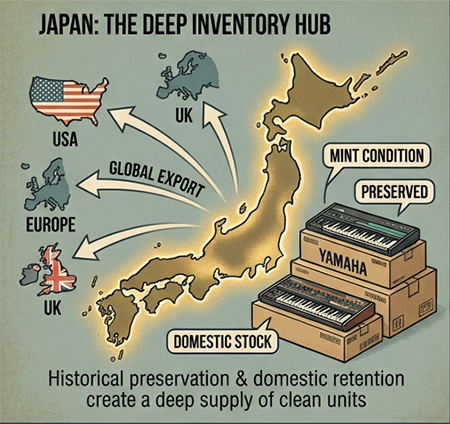 The reason Japan sits at the center of this market is both historical and behavioral. Yamaha Corporation built and sold a large portion of its flagship instruments domestically during the peak decades of hardware synthesis. Many of those units stayed put.
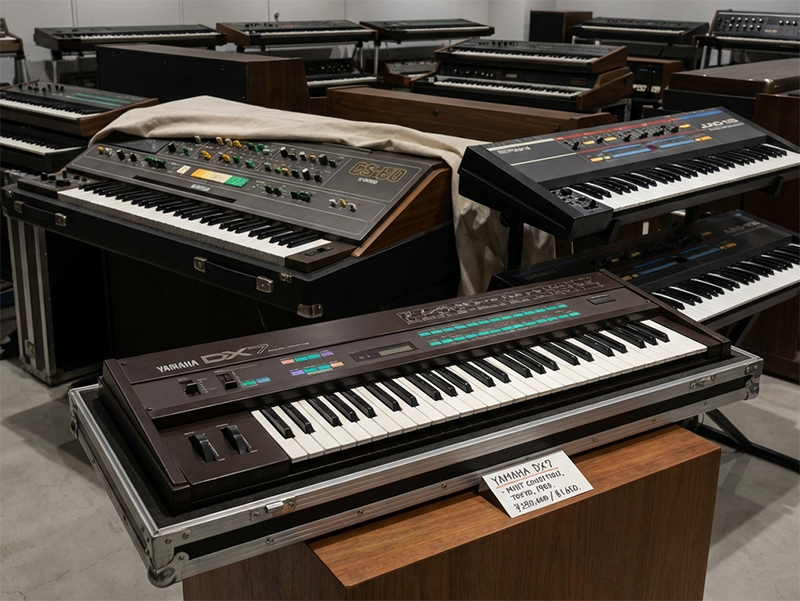
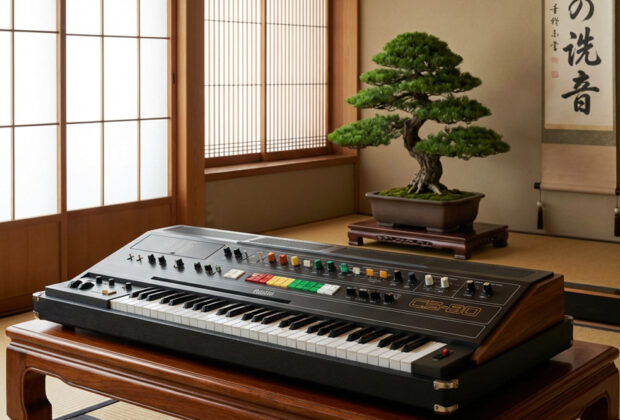
Unlike the U.S. and Europe—where studios turned over gear aggressively—Japan retained it. Equipment was stored, maintained, and, crucially, preserved. That preservation now translates into supply. When a buyer in New York or Berlin goes looking for a clean example of a Yamaha DX7 or a Yamaha CS-80, Japan is often where the search ends.
But it’s not just that Japan has inventory. It has the best-looking inventory. And in today’s market, that distinction matters more than ever.
The “Japan Premium” Is Real
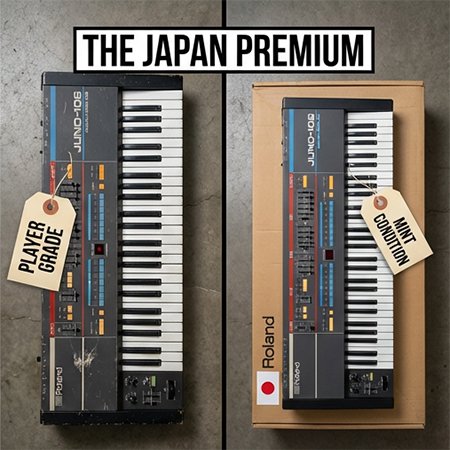
There’s a widely accepted—if sometimes overstated—belief that Japanese sellers offer better condition gear. Cleaner panels. Less corrosion. Fewer missing parts. Whether universally true or not, the perception is enough to move prices.
A decade ago, a DX7 was almost a throwaway instrument. You could find one for a few hundred dollars, sometimes less. Today, clean units regularly transact in the $800–$1,500 range, with Japan-origin listings often setting the upper bound.
At the high end, the shift is more dramatic. The CS-80, once simply “rare and heavy,” is now firmly in trophy territory. Verified transactions in the past few years have clustered between roughly $60,000 and $100,000 depending on condition, servicing, and provenance. That’s not a musician’s purchase decision. That’s a collector’s.
The same pattern holds across brands:
- Roland Jupiter-8: frequently trading between $18,000 and $30,000, with pristine Japanese units pushing higher
- Roland Juno-106: once a $500 workhorse, now commonly $1,500–$3,000
- Korg M1: still relatively accessible, but clean, boxed examples are beginning to separate from “player-grade” units
In each case, condition—and increasingly origin—is driving the spread.
Arbitrage, Currency, and a Global Marketplace
 There’s also a financial engine underneath all of this. Japanese sellers are not pricing for domestic buyers; they’re pricing for a global market.
A weaker yen at various points over the past few years has made exports more attractive. Platforms like Reverb and eBay remove friction, allowing sellers in Tokyo or Osaka to access buyers in Los Angeles, London, or Berlin instantly. The result is a kind of continuous arbitrage: instruments are listed at the highest price the global market will tolerate, not what a local musician might pay.
Japan, in effect, has become a price-setting hub.
The Subtle but Crucial Shift: Who Is Buying?
The most important change isn’t where the gear is coming from. It’s who is buying it—and why.
More and more, these instruments are being purchased as stores of value.
You can see it in the language of listings: “all original,” “collector condition,” “museum quality.” You can see it in buyer behavior: instruments that are rarely gigged, rarely modified, often not even integrated into working studios. They are preserved.
This is where the comparison to the U.S. fine art market stops being metaphorical and starts becoming structural. Like a painting, the value of a vintage synthesizer increasingly depends on scarcity, condition, and narrative. The fact that it can make music is almost secondary.
A fully serviced, modified synth that sounds better might actually be worth less than an untouched original. That inversion tells you everything. (Ironically, the reverse is true for vintage guitars, which are specifically sought to be played for their tone. Well-worn, highly used, beat up, vintage guitars are more valuable than "case queens" whose components have not been appropriately broken in for their age, creating great looking, old instruments that just don't have the same magical tone as the instruments with decades of abuse on them.)
Meanwhile, the Music Industry Has Changed Completely
Here’s the tension at the center of this trend: the economics of music creation no longer support the cost of these instruments.
Streaming has fundamentally compressed revenue for most musicians. Outside of the top tier, income from platforms like Spotify and Apple Music is measured in fractions of a cent per stream. Even successful independent artists often rely on touring, licensing, or teaching to stay afloat. Against that backdrop, a $25,000 synthesizer—or a $75,000 one—becomes difficult to justify as a working tool. And yet prices keep rising.
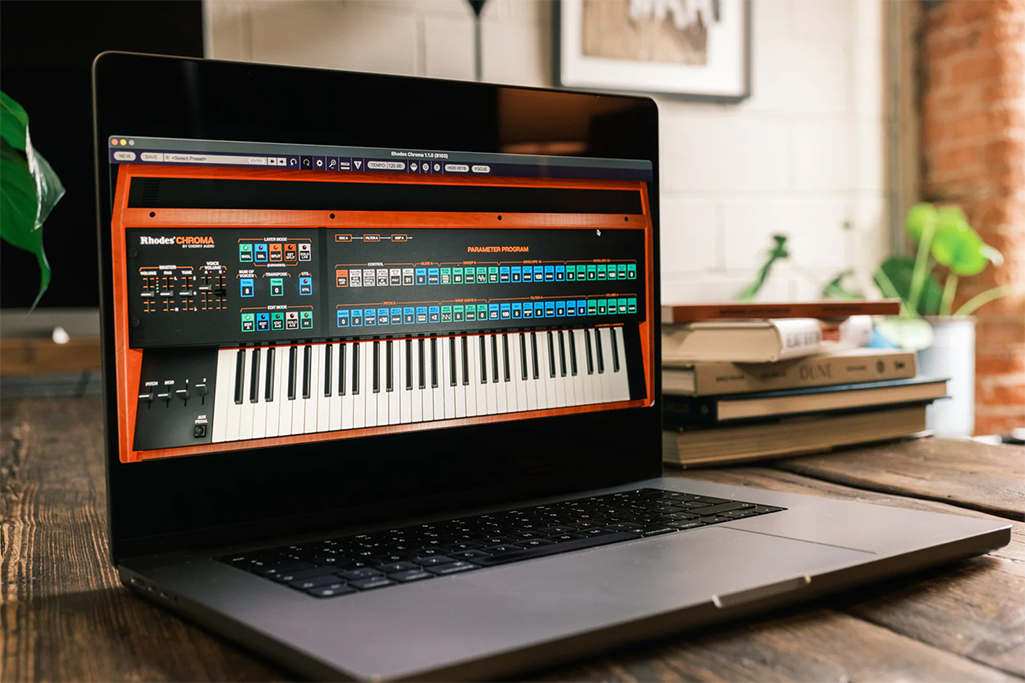
That disconnect is the clearest signal that this is no longer a purely musician-driven market. If anything, musicians are being priced out of the very instruments that defined earlier eras of music production. Software instruments, modular reissues, and modern digital synths now carry the functional workload. Vintage gear carries the cultural and financial weight.
Short Term: Momentum and Visibility
In the near term, expect more of the same. Japanese listings will continue to dominate visibility, partly because they’re export-oriented and highly present on global platforms. Prices for top-tier instruments—CS-80, Jupiter-8, Prophet-5—are likely to remain strong, if not continue climbing.
There may be some volatility in mid-tier instruments. The Yamaha DX7 and Roland D-50, for example, sit in an interesting position: historically abundant, sonically iconic, but not truly rare. Prices could fluctuate as supply continues to surface from Japan and elsewhere.
Condition and doing your Homework
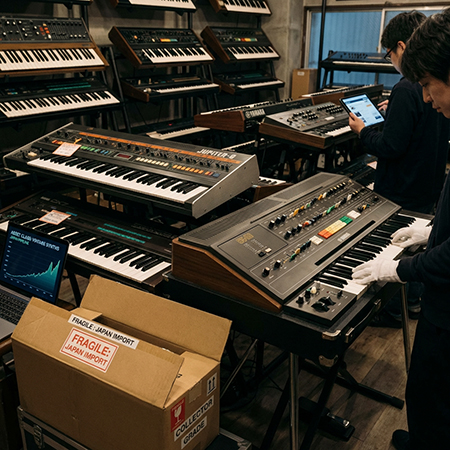 One thing that consistently jumps out when Japanese synths start landing in the U.S. market is just how well they’ve been cared for. Broadly speaking, Japanese collectors treat their gear with a level of attention that’s… let’s just say noticeably different from what we often see stateside. Yes, components age—capacitors drift, plastics yellow, things wear out because that’s how physics works—but many of these instruments arrive in condition that’s years, sometimes decades, better than their American counterparts. You’ll also see a lot of higher-end listings labeled “serviced,” which can mean anything from basic maintenance to a full overhaul. The default reaction in some circles is skepticism—and that’s fair—but the smarter move is simple: ask detailed questions, verify what “serviced” actually entails, and do the same due diligence you would with any piece of gear, new or used.
Long Term: A Split Market
Over a longer horizon, the market is likely to bifurcate more clearly. On one side: collector-grade instruments. Pristine, original, often Japan-sourced. These behave like fine art or vintage watches—thin supply, high prices, long holding periods.
On the other: player-grade instruments. Functional, perhaps modified, cosmetically imperfect. These will continue to circulate among musicians and may not see the same appreciation. The gap between those two categories will widen.
The Bigger Picture
What’s happening with vintage Yamaha synthesizers—and the broader wave of gear coming out of Japan—isn’t just about geography or nostalgia. It’s about financialization. Objects that were once tools are being reclassified as assets. Markets that were once driven by musicians are now influenced by collectors and investors. Pricing is increasingly disconnected from utility and tied instead to scarcity, condition, and story. In that sense, the comparison to the fine art market isn’t just apt—it may be predictive. Because once an object crosses that line, it rarely goes back.