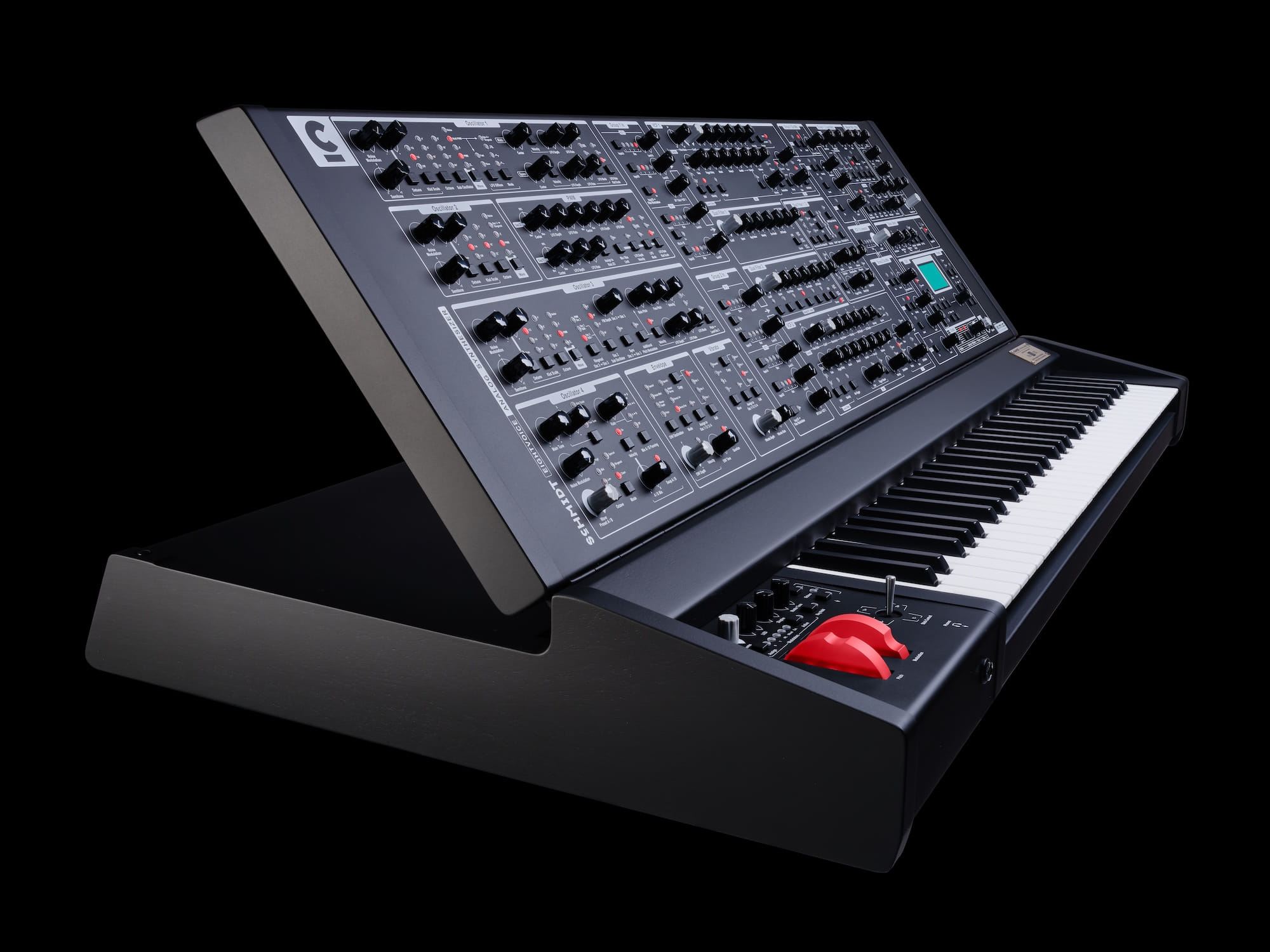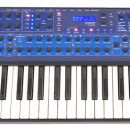
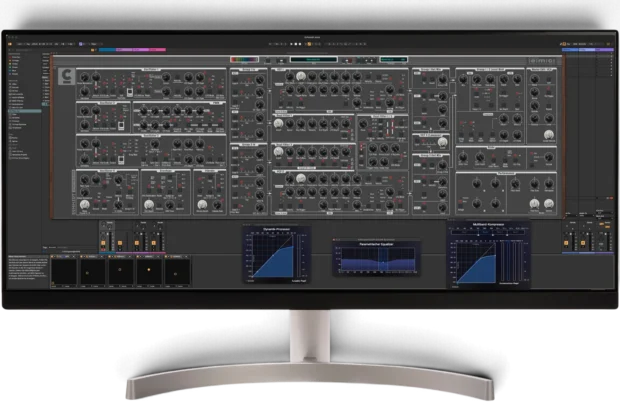
 LANGENAU, GERMANY: Coinciding with an announcement that the no-expense-spared Schmidt Eightvoice Analog Synthesizer, surely one of the most striking analogue instruments ever conceived, is set to cease production after 15 years once the last remaining units of its current Classic and just-announced 20 units of The Final Series have been sold, Schmidt-Synthesizer, Powered by e:m:c (electronic music components), is proud to announce availability of the Schmidt Vi virtual recreation — duly developed in close collaboration with UJAM in AAX, AU,VST, and VST3 plug-in formats with all of its inspirational hardware namesake’s features fully implemented with some welcomed extras thrown in for good measure, allowing anyone to appreciate authentic and sophisticated sounds, as well as integrate them into the digital music production realm, all at a comparatively pocket-friendly price — as of November 10…
It is fair to say that the response to the Schmidt Eightvoice Analog Synthesizer was overwhelming following its introduction at Musikmesse 2012 in Frankfurt, Germany. After all, it had been many years since an analogue synthesizer of its immensity — let alone a polyphonic one featuring so much in the way of hands-on control — had been available. As such, it also turned heads when (ad)venturing across the pond for a repeat performance at The 2013 NAMM Show in Anaheim, CA, USA. Ultimately, the decision was made to bravely build an initial production run of 25 units, although, as it happened, this was far from the end of the story… the rest, as they say, is history.
Having decided that the Schmidt Eightvoice Analog Synthesizer should be entirely manufactured in Germany, regardless of running the risk of incurring high production costs by building it in a distinctly non-compromising ‘old school’ way — without specialised components and using a through-hole construction method to ensure straightforward repairs in the long term, in other words, a great success story subsequently transpired. Today, there are well over one hundred of these no-expense-spared synthesizers in the wild, but technological developments and rising costs associated with manufacturing complex devices worldwide have culminated in the way that Schmidt-Synthesizer beautifully builds its impressive instrument being no longer viable in the long run, sadly.
Schmidt-Synthesizer had, however, been collectively mulling over the idea of effectively creating a digital copy of the Schmidt Eightvoice Analog Synthesizer for quite some time. Thanks to a longstanding friendship with key members of the leadership team at UJAM — the fellow German operation that made the most advanced platform for building sample instruments and the first choice for professional audio plug-in developers worldwide, founded by Academy Award-winning film-scoring supremo Hans Zimmer, one of the greatest (arguably) and one of the most prolific composers (certainly) of our time, noted for his innovative integration of electronic sounds with traditional orchestral arrangements, and American musician, singer, songwriter, record producer, and fashion designer Pharrell Williams, among others, Schmidt-Synthesizer was able to have a productive dialogue with the top-tier company concerned.
Cue the start of a new chapter in Schmidt-Synthesizer’s story — successfully bringing one of the finest analogue synthesizers ever built to bear upon the future of music production. Put it this way: while developing its Schmidt Vi virtual recreation, the Schmidt Eightvoice Analog Synthesizer’s analogue signal path was meticulously analysed at the deepest level possible courtesy of an entirely new modelling process whereby every circuit behaviour, every subtle interaction, and every sonic nuance was studied with extraordinary precision.
As a result, the unmistakable characteristic of the Schmidt Eightvoice Analog Synthesizer — including some truly unique features such as its chain of five ring modulators fed by six pulse waves, each with different pulse-widths, capable of creating colder, wavetable-like sounds that had never before been implemented in an analogue synthesizer, never mind an analogue programmable polysynth — can now become an integral part of anyone’s digital music production environment. From factory sounds to performance behaviour, its striking sonic personality — forged from a sound generation engine featuring almost everything that subtractive synthesis has to offer, such as an oscillator section providing functions for shaping seriously complex sounds that are unlikely to have made an appearance in the analogue domain thus far, a powerful filter section akin to a fully-programmable modular synthesizer system, and modulation routings exceeding anyone’s wildest dreams — has been seamlessly transferred into any DAW (Digital Audio Workstation) platform, preserving the emotional impact, warmth, and dimensionality of the original analogue synthesizer with an unprecedented level of authenticity.
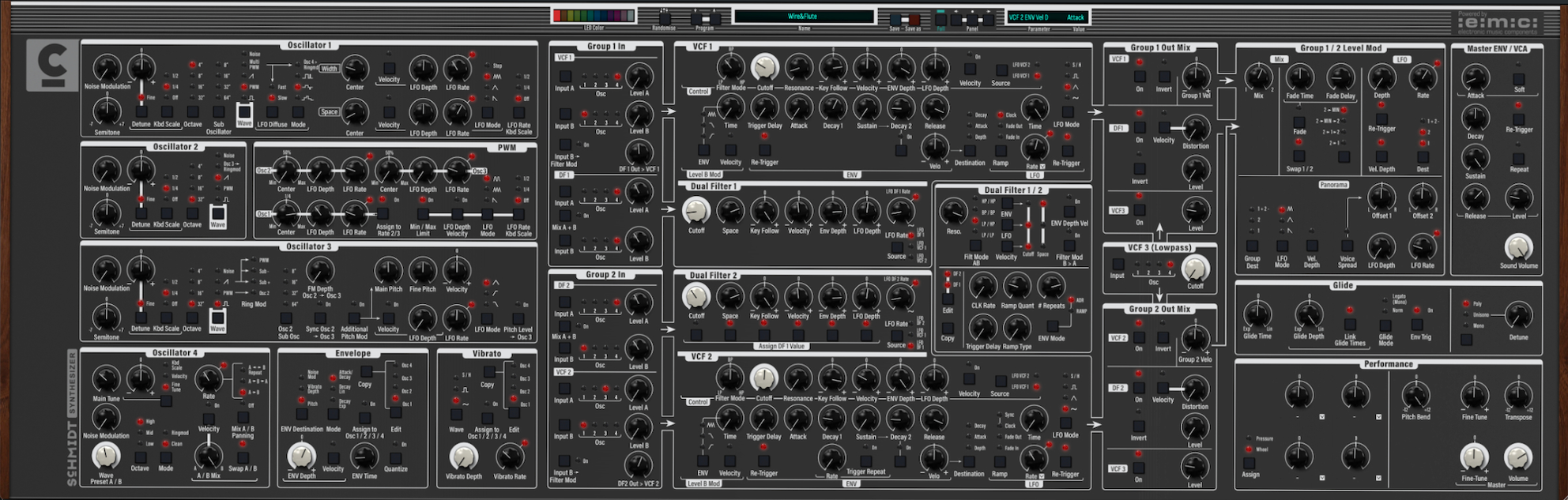
An early prototype of Schmidt Vi was unveiled earlier this year to an appreciative audience at SUPERBOOTH26 in Berlin, Germany, where it quickly became abundantly clear to Schmidt-Synthesizer that it was already on the right track. The finished plug-in itself is the continuation of an extraordinary instrument’s legacy. Let it be known, then, that everything is implemented — including the Schmidt Eightvoice Analog Synthesizer’s sophisticated glide/portamento capabilities and several realtime modifiers, fully programmable per preset — right down to ‘replicating’ the hardware’s changeable multi-colour LEDs (Light Emitting Diodes) courtesy of the LED Color selector on Schmidt Vi’s gorgeous GUI (Graphical User Interface), itself effectively mirroring the Schmidt Eightvoice Analog Synthesizer’s spacious front panel. Though the latter’s large LCD (Liquid Crystal Display) with changeable colour background appears to have been ‘replaced’ by Schmidt Vi’s Performance controls, its functionality remains — readily positioned across the top of that GUI in a reimagined form better suited to the virtual instrument plug-in’s onscreen operation.
On the face of it, Schmidt Vi is — to all intents and purposes — a Schmidt Eightvoice Analog Synthesizer in software. Saying that, though, not only have all the Schmidt Eightvoice Analog Synthesizer’s fanciful features been fully implemented in Schmidt Vi but Schmidt-Synthesizer, Powered by e:m:c (electronic music components), has seen fit to throw in some welcomed extras for good measure — namely, knob positions representing actual values, MPE (MIDI Polyphonic Expression) support, MIDI Learn functionality, and a random sound generator that often produces surprisingly splendid results.
That the Eightvoice Analog Synthesizer wording has been dropped from Schmidt Vi’s nomenclature makes sense. After all, the virtual instrument plug-in itself is not analogue, nor, strictly speaking, is it restricted to being an eight-voice synthesizer. Whatever way one views it, anyone who has ever dreamed of having access to the Schmidt Eightvoice Analog Synthesizer’s striking sound — but baulked, perhaps, at the premium price tag attached to bringing it to life in the most uncompromising way imaginable — need dream no more. It is little wonder, then, that Schmidt Vi is being billed by its creator as The Virtual Recreation Of A Dream.
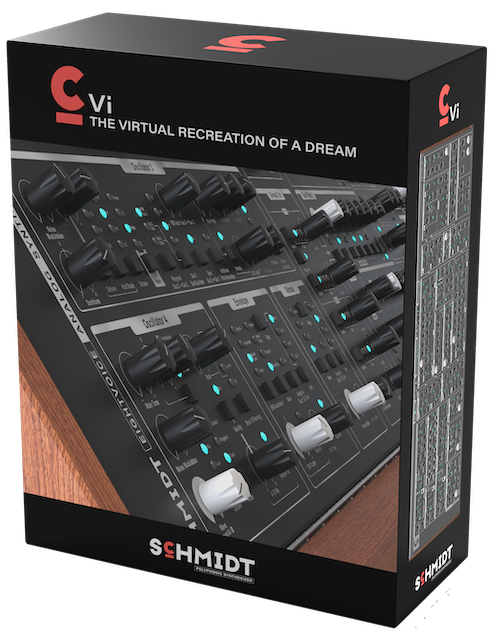 Pricing and Availability:
Schmidt Vi is available — as a 64-bit AAX-, AU-, VST-, and VST3-compatible virtual instrument plug-in (protected by iLok copy protection) for Mac (OS X 10.15 or higher, ARM processor compatible) and as a 64-bit VST- and VST3-compatible virtual instrument plug-in (protected by iLok copy protection) for PC (Windows 7 or higher) with 64-bit AAX compatibility available for PT 12 or higher (PC) with widescreen or single screen, split panel operation — at an introductory price of €179.00 EUR (before rising to its regular price of €199.00 EUR) directly from the new Schmidt-Synthesizer website here: https://www.schmidt-synthesizer.com (Schmidt Vi is also available to buy from fellow German high-quality synthesizer developer Waldorf’s online Shop here: https://waldorfmusic.com/shop-english/)
For more in-depth info, please visit the dedicated Schmidt Vi webpage via the new Schmidt-Synthesizer website here: https://www.schmidt-synthesizer.com
Become better acquainted with Schmidt Vi while watching a brief but informative introductory video by Axel Fischer — credited with product management at Schmidt-Synthesizer — here: https://tinyurl.com/2tfn7by3