The Cities Are Buzzing. The Real Question Is: Where Should an Artist Build?
Every so often, a piece of research comes along that does more than inform. It reframes the conversation. That is what happened when I read the Princess Polly “Best Concert Cities 2026” report. On the surface, it is aimed at fans, ranking where people are likely to have the best live music experience. But for working musicians, especially independent artists trying to build something sustainable, the report suggests a very different question: not simply where concerts are happening, but what kind of opportunity a city actually offers.
And that question becomes even more revealing when the Princess Polly rankings are considered alongside Wiingy’s research on the most musical cities in America.
Taken together, the two reports point to a distinction many artists overlook: the best cities to play are not always the best cities to grow a career.
That is the core strategic insight.
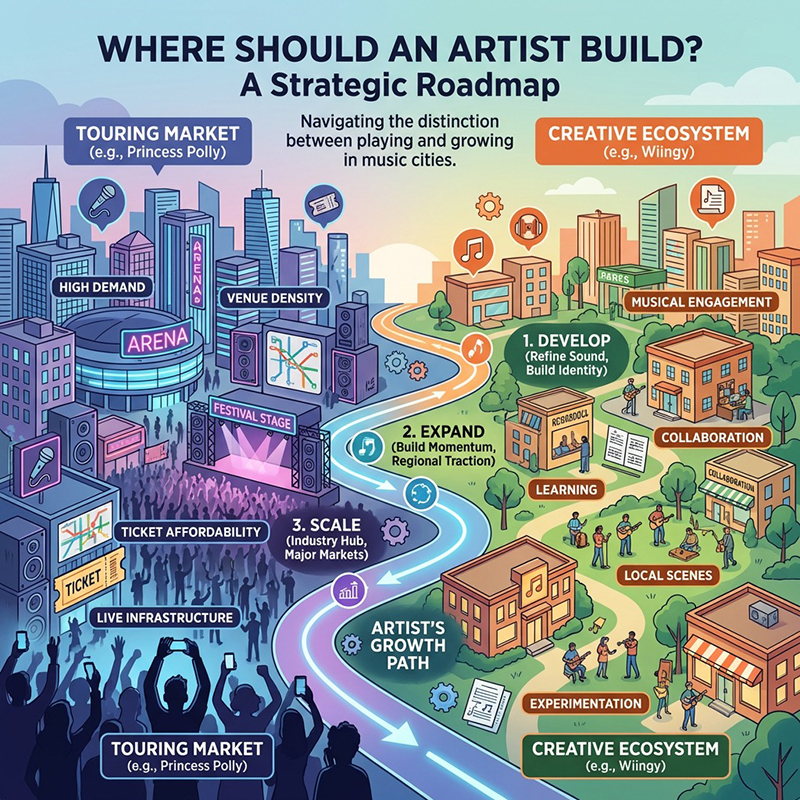
Princess Polly is largely measuring where concerts happen. Its rankings are built around live music infrastructure and consumer demand: concert volume, venue density, festivals, ticket affordability, transit, and other factors that shape the experience of going out to see a show. In plain terms, it identifies cities where live performance is active, accessible, and supported by audience behavior. These are touring markets. They have stages, calendars, ticket buyers, and enough momentum in the live sector to sustain frequent events.
Wiingy is measuring something different. Its research is less about concert throughput and more about musical engagement itself: where people are learning instruments, searching music topics, participating in music culture, and living close to the practice of music. In plain terms, it points toward creative ecosystems. These are places with higher concentrations of musicians, collaborators, learners, and local scenes that often support experimentation and artistic development.
That difference matters more than it may seem at first.
Artists often talk about “music cities” as though all music cities function the same way. They do not. Some cities are strong because they generate audience demand. Others are strong because they generate artistic density. Sometimes those overlap. Often they do not. And when artists fail to distinguish between the two, they make strategic mistakes.
A city that is excellent for playing shows is not automatically the best place to refine a sound, find collaborators, or gain traction as an emerging act. Likewise, a city rich with musicians and cultural participation is not automatically the easiest place to sell tickets or stand out in a crowded field.
This is where the two reports become especially useful. Princess Polly shows where the audience infrastructure is already working. Wiingy suggests where the creative substrate is strongest. One report is about live demand. The other is about musical participation. Combined, they create something more valuable than either list on its own: a roadmap for how independent artists can think about growth in phases.
That also helps explain one of the hidden paradoxes inside both reports. The most famous music cities are not always the most advantageous places for an artist to begin.
| The Top 10 Best Major U.S. Cities to attend a Concert 1. Las Vegas, NV |
New York, Los Angeles, Nashville, and Austin carry enormous cultural weight, and for good reason. They offer venues, studios, schools, industry relationships, and a constant flow of talent. But that same density can work against the developing artist. Infrastructure creates opportunity, but it also intensifies competition. In these markets, you are not just entering a scene. You are entering an ecosystem where the baseline level of competence is already high and where attention is scarce.
That is one of the most overlooked implications of the Wiingy data. A city can be musically rich and still be difficult terrain. High musical engagement does not necessarily mean high openness for any one artist trying to break through. In fact, it may mean the opposite. The more musicians, institutions, and industry actors a city has, the harder it may be to distinguish yourself unless you already have momentum, a defined identity, or measurable audience pull.
This is why major music capitals can be competitive without being especially supportive.
By contrast, some of the most strategically interesting cities are the mid-tier markets that do not always dominate the mythology of the music business. Princess Polly highlights places like San Diego, where ticket affordability is a major advantage, Oklahoma City, where costs are lower, and Austin, where festivals create a constant cycle of visibility and discovery. For independent artists, these kinds of cities may offer a more functional path to growth. Lower friction for audiences, lower operating costs, less saturation, and more chances to become familiar to a local or regional crowd can create the one thing most careers actually need: repeatable momentum.
That phrase matters more than “music capital.”
Too many artists chase prestige instead of momentum. They target cities because the names are big rather than because the conditions are favorable. But the most useful question is not whether a city looks impressive on paper. It is whether you can build there. Can you play often enough to improve? Can fans afford to come back? Can you find collaborators? Can you become known in a scene before being swallowed by it?
From that perspective, venue density may matter more than venue prestige.
Nashville’s leadership in venues per capita is significant not because it signals glamour, but because it signals repetition. For an indie artist, more rooms often means more shots on goal. More gigs mean more reps, more data, more audience feedback, more relationships, and more opportunities to tighten the growth loop between performance and traction. A city with many workable rooms may be more useful than a city with a few famous ones.
The same logic applies to festivals. Austin’s strength in festival density is not just a tourism asset. It is a career variable. Festivals compress opportunity. They place audiences, artists, promoters, and media in the same environment and accelerate discovery in ways that ordinary show calendars often cannot. For emerging artists, that kind of concentrated exposure can matter far more than a single prestige booking.
Affordability deserves similar attention. It is often treated as a lifestyle consideration, but for independent musicians it is fundamentally a career variable. Lower-cost cities reduce burn rate, extend creative runway, and make touring or regional play more viable. That is not secondary to the work. It directly shapes how long an artist can stay in motion, how often they can perform, and how much risk they can absorb while building.
Once you look at the two reports this way, a more practical strategy starts to emerge.
| The Most Musical U.S. Cities
1. Asheville, NC |
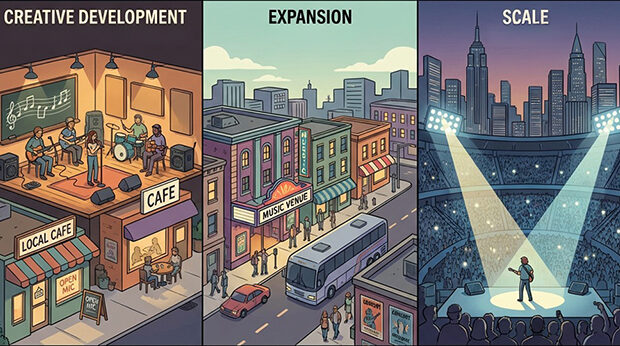
The first phase is creative development. This is where musically engaged cities matter most. Artists need collaborators, small rooms, experimentation, and a scene where participation is active enough to sharpen the work. The goal here is not scale. It is refinement. You are building the sound, the set, the identity, and the relationships that make a career durable.
The second phase is expansion. This is where strong mid-tier concert cities become powerful. Artists who have developed a clear offering can begin targeting markets with good venue density, affordable logistics, and audiences accustomed to live music. The goal is to turn scattered support into regional traction, to build consistency in ticket sales, attendance, and recognition.
The third phase is scale. Only then do the major hubs become most useful. Cities like New York, Los Angeles, Nashville, and Las Vegas can offer larger shows, stronger industry visibility, better press opportunities, and deeper professional networks. But these cities tend to reward artists who arrive with evidence, not just ambition. They reward positioning, momentum, and legibility.
That may be the biggest takeaway most musicians miss.
The objective is not to chase the biggest city as early as possible. It is to build a sequence of environments that each serve a different function. One city may help you become better. Another may help you become visible. Another may help you become scalable. Those are not always the same city, and treating them as though they are can stall a career before it has had the chance to mature.
So when artists evaluate where to focus, they should ask better questions. Not just: Is this a music city? But: Can I play here often? Can fans afford to see me? Are there musicians here to collaborate with? Is the scene active without being so saturated that I disappear into it?
The best cities do not necessarily score perfectly across all categories. But the most strategically useful cities often score well on at least three: venue access, audience affordability, musical engagement, and manageable competition.
That is what these two reports, read together, really reveal.
Princess Polly shows where concerts are happening. Wiingy shows where music is being lived. One maps demand. The other maps participation. Combined, they offer a smarter lens for artists trying to make decisions in a difficult industry.
Because the best cities to play are not always the best cities to grow in.
And for independent musicians, knowing the difference can be the difference between chasing noise and building a career.
Source attribution: Princess Polly “Best Concert Cities 2026” report; Wiingy “Most Musical Cities in America” research.