Michael Whalen is a two-time Emmy Award-winning composer and music supervisor, recording artist, producer, and music industry career coach through his company, Artist Expansion. Learn more at www.michaelwhalen.com.
The music business is changing right now — at this exact moment. Not gradually. Not hypothetically. Now. Artificial intelligence and new technologies are already embedded in everyday creative and business workflows, raising real questions about copyright, compensation, attribution, and what we even mean when we say “authorship.” Social media is loud with anxiety, hot takes, and dystopian predictions, but beneath all that noise, something important is happening: the industry is not abandoning creativity. It is actively defining how technology should serve it. Artists must be part of that conversation. You must be part of that conversation.
If you are waiting to be “taken out” by artificial intelligence, you are surrendering agency you never lost. That mindset is not caution — it is abdication. History tells us a very different story. Every major technological shift in music has been accompanied by fear. Player pianos were supposed to end live performance. The phonograph was meant to destroy musicians’ livelihoods. Electric guitars were dismissed as artificial noise. Synthesizers were accused of killing “real” musicianship. Drum machines were said to eliminate drummers. Sampling was framed as theft rather than authorship. Digital recording was blamed for soulless music. And yet, every one of these tools ultimately expanded music — artistically, culturally, and economically — because human beings used them with intention.
“Artificial intelligence can generate content,
but it cannot generate meaning.”
Jimi Hendrix was not erased by the electric guitar. Brian Eno was not replaced by tape loops. Herbie Hancock was not overtaken by synthesizers — he defined how they could swing. Kraftwerk did not remove humanity from music; they reframed it. The pattern is consistent. Technology does not make art. People do.
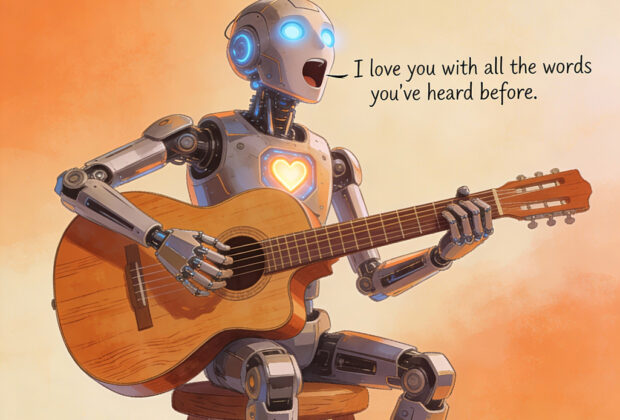
Artificial intelligence can generate content, but it cannot generate meaning. It does not have lived experience, emotional memory, cultural context, or physical presence. It does not take personal risk. It does not build relationships with an audience over time. AI does not wake up at three in the morning with a melody tied to grief, joy, fear, or love. It does not change how it plays because a room feels tense. It does not respond to the breath of an audience. Humans create art because art is intentional expression, not statistical recombination. A machine can imitate style, but it cannot originate purpose.
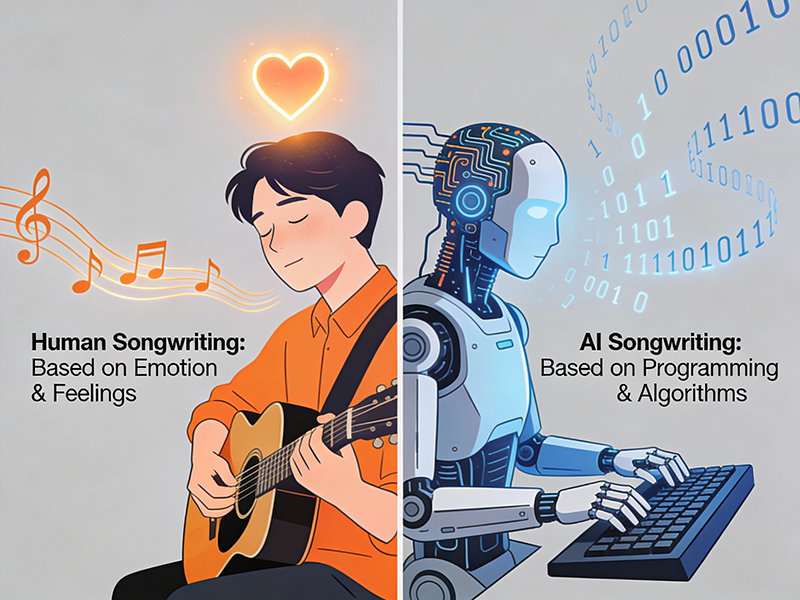
The real threat facing artists today is not artificial intelligence. The real threat is invisibility. What matters more than ever is inspiration paired with intentional strategy. The tools available today can amplify good decisions, but they cannot replace your vision, your taste, your collaborators, or the trust you have built with your audience. If your work is anonymous, interchangeable, and disconnected from your story, any system — human or machine — can replace it. If your work is personal, embodied, and contextualized, it cannot.
The way forward is not to hide from technology but to out-human it. Artists must make the human element visible. Show your process. Let people see how the work is made — the sketches, drafts, demos, revisions, and failures. Art does not live only in the finished product; it lives in the journey. Show your performance. Physical presence still matters, whether live, streamed, or recorded. Performance reveals micro-choices that no algorithm can replicate. Provide context. Why this piece? Why now? Why you? Meaning emerges through narrative. Reveal personality. Your humor, your doubts, your contradictions, and your values are not branding exercises — they are authorship. And above all, cultivate relationship. Fans do not connect to files. They connect to people. Trust is built slowly, not generated on demand.
There are listeners who care deeply whether a human being made the music they love. That audience is not disappearing. It is becoming more discerning. Your responsibility is not to compete with machines but to highlight your humanity so clearly that comparison becomes irrelevant.
At the same time, authorship itself is being renegotiated in real time. Questions around ownership, training data, consent, and compensation are not theoretical — they are unfolding now. If artists are not actively participating in shaping these frameworks, they will be shaped without them. This requires understanding how AI tools work, demanding transparency, advocating for consent and fair compensation, and aligning with platforms and organizations that protect creators. Silence is not neutrality. Silence is forfeiture.
Humans make art. Artificial intelligence cannot. AI can assist, accelerate, analyze, and automate, but it cannot care. Your advantage has never been technical perfection. It has always been meaning. The future does not belong to artists who retreat. It belongs to artists who show up clearly, publicly, and intentionally and claim their role in shaping what music is becoming. This moment is not a threat. It is an invitation. Be visible in your process. Be present in your performance. Be unmistakably human…