 HONG KONG: independent audio software developer Ravine DSP is proud to introduce V1.3 of its Inter::State plug-in host for already-owned effects — enhanced with new Slot Scenes storing eight tonal states from one plug-in and an ability to switch, morph, or tempo-crossfade between them without building extensive DAW (Digital Audio Workstation) automation — as of July 30…
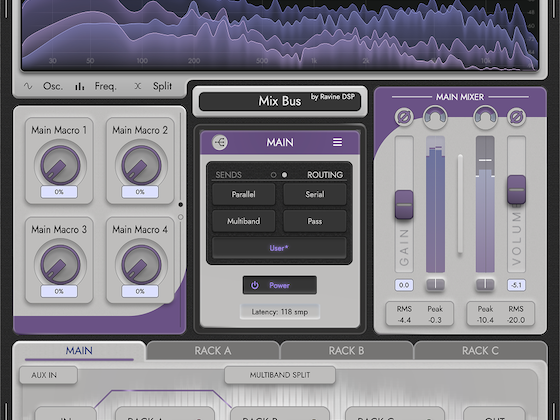
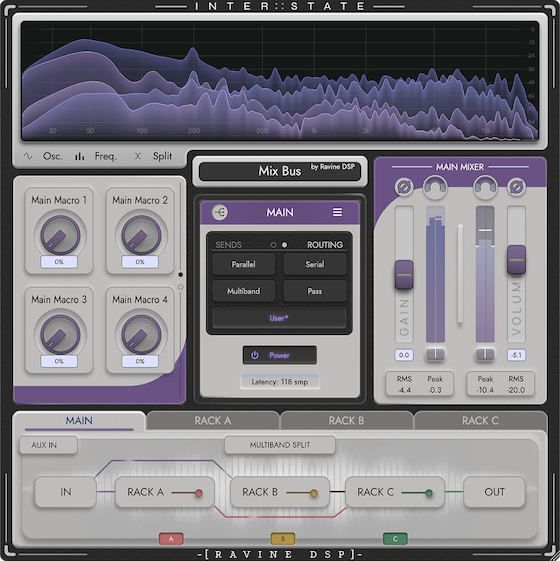
As a plug-in host for already-owned effects, Inter::State effectively eliminates the clutter of floating plug-in windows and fragmented MIDI (Musical Instrument Digital Interface) mappings. Ultimately, users can build an effects chain once, map its macros and modulation, then reopen the whole thing exactly as they left it — in any DAW, in any session. Think three racks, eight scenes in every slot, and mixing at every level — MAIN, RACK, and SLOT — inside one insert and its overriding benefit becomes abundantly clear: create complex chains in one fixed workspace with the greatest of ease.
It is possible, therefore, to build serial, parallel, multi-band, and send-style structures inside each of those three racks with one routing view; control those MAIN, RACK, and SLOT targets from dials, sliders, MIDI, or automation; and save a rack or a full session to a file and reopen it in any DAW — plug-in states, macro mappings, and modulators included. Inter::State’s visualiser, macros, mixer, and racks stay in fixed positions — only core content changes with context, so the layout never moves.
Thanks to V1.3’s introduction, Inter::State improvements are anchored around new Slot Scenes saving the hosted plug-in’s parameter state (and, optionally, its mixer settings) inside each slot, allowing users to instantly recall a scene storing eight tonal states from one plug-in, morph between adjacent scenes, or launch a timed, beat-synched transition, as well as making those scenes playable by driving them from macros, MIDI (Musical Instrument Digital Interface), host automation, the modulator — itself representing Inter::State’s rhythmic layer on a macro dial, or Ravine DSP’s workflow-centralising companion Inter::State[Bridge] utility.
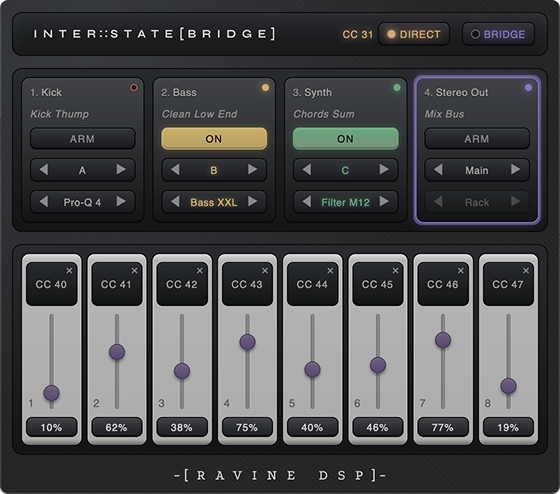 Inter::State[Bridge] itself is designed to centralise the workflow of managing separate automation lands and MIDI mappings across multiple tracks in a large session, which would otherwise quickly become tedious work. When loaded once in a project as a virtual instrument, it acts as a simple, reusable control surface. So when a user automates or MIDI-maps the eight sliders on its dedicated track, those values are instantly broadcast to subscribed MAIN macros on any Inter::State instance loaded across the entire project, and direct tiles allow for control over specific Inter::State instances within the project. Put it this way: zero-latency shared memory architecture for the real-time automation data allows a single fader move or DAW automation curve on the Inter::State[Bridge] track to orchestrate macro changes across multiple tracks simultaneously — such as a global filter sweep or parallel send adjustment — without requiring duplicate automation lanes on every channel.
Clearly, Inter::State, improvements courtesy of its V1.3 update, and Inter::State[Bridge] are all the result of someone who knows their onions. Over, then, to the founder of Ravine DSP, Craig Lopez: “Inter::State began strictly as a utilitarian VST3/AU host to solve complex DAW routing headaches and loudness bias. Version 1.3 is where it crosses over into a creative environment. The new Slot Scenes system gives you eight parameter snapshots for any hosted plug-in, which can clearly reduce the need for duplicate plug-in instances. But the core of the update is how you navigate those snapshots. You can use Selector mode to instantly snap between settings, Morph to continuously blend between static states to find custom sweet spots, or Crossfade to transition any track’s processing from one section of a song to the next over a set musical duration — without drawing complex DAW curves. Combining those transitions with Inter::State’s zero-added-latency Auto-Gain means you can rhythmically sequence extreme parameter shifts without causing chaotic volume jumps or clipping. It merges strict utilitarian control with complete creative freedom, blurring the line between clinical mixing and sound design.”
 Pricing and Availability:
Inter::State (including its companion Inter::State[Bridge] utility) is available to buy as a 64-bit VST3- and AU-formatted plug-in compatible with major hosts (including Ableton Live, Apple Logic Pro, Cockos Reaper, and Steinberg Cubase) for macOS (10.13 or newer) and Windows (10 or 11) at a discounted ‘Founders Edition’ price of $69.00 USD/€60.00 EUR — rising thereafter to its regular price of $99.00 USD/€85.00 EUR — directly from Ravine DSP here: https://www.ravinedsp.com/shop (Owners of earlier versions of Inter::State can update to V1.3 for free, while a seven-day unrestricted trial is also available for those wishing to try before they buy.)
For more in-depth Inter::State information, please visit the Ravine DSP homepage here: https://www.ravinedsp.com