
Preface: Don't be fooled by the Rhodes company name. This is not a virtual piano plug-in!
The good folks at Rhodes have been busy of late. In addition to their fabulous hardware pianos and limited editions, they’ve been busy in the software world, delivered the excellent-sounding Rhodes piano plug-in as well as the brand-new Wurlitzer plug-in just reviewed.
More recently, Rhodes released the Vari-amp plug-in, an interesting tool that combines six Rhodes preamps with a selection of seven amplifiers and seven microphones. While clearly inspired by classic Rhodes signal chains, this is a signal processing/effects plug-in designed to be used with a variety of instruments—not just a Rhodes piano. But of course the obvious use case is that you've got a Rhodes piano, virtual or otherwise, but lack the variety of classic amplifiers/preamps/mics that were paired with the iconic keyboard over the years in order to deliver some of its most notable recordings. That said, since we have a 1978 Mk I Rhodes in our studio, we started there.
| Category | Value | Rating |
| Features | 20% |  |
| Usability | 25% | |
| Sound | 25% | |
| Documentation & Support | 10% | |
| Price | 20% | |
| OVERALL RATING = 3.5 Stars (out of 4) 3.6 stars or better: Outstanding, WIHO Award 3 stars or better: Worth considering 2 stars or better: Suited to specific needs 1 star or less: Not recommended |
||
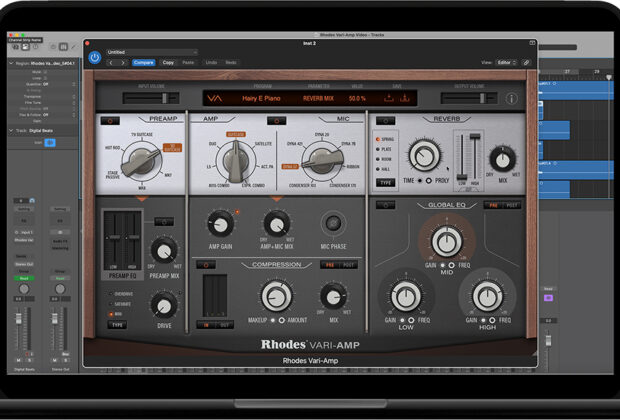
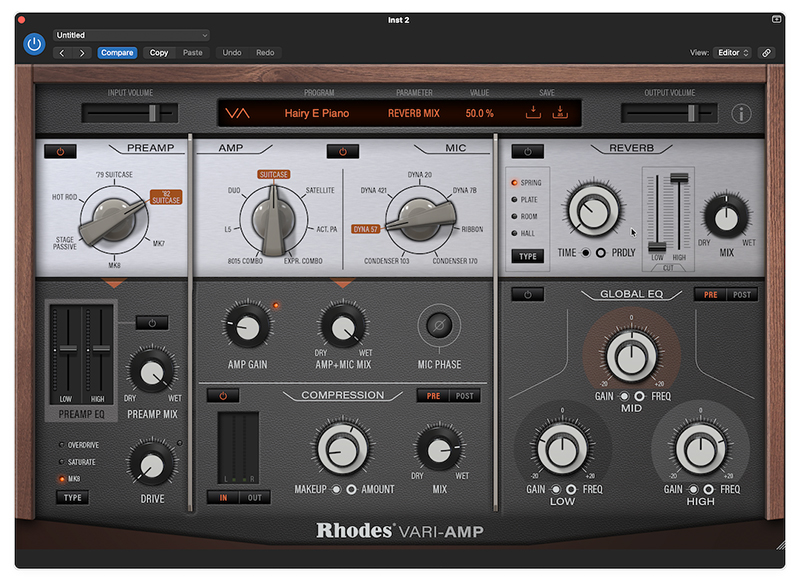
The interface is divided into three main sections: Preamp, Amp/Mic, and Reverb (which also includes Global EQ). The Preamp section features a chicken-head selector with options including ’79 Suitcase, ’82 Suitcase, Mk7, Mk8, Stage Passive, and Hot Rod. Stage Passive reflects a traditional passive Rhodes (like our Mk I), while the Hot Rod setting appears to emulate a modified signal path with increased gain and EQ flexibility. Additional controls include preamp EQ, mix, and drive.
The Amp section also uses a selector knob with seven choices, including Suitcase, Satellite, Act.PA, Expr.combo, 8015 combo, L5, and Duo. While the naming avoids specific brand references, we were able to infer most of the models. The Suitcase and Satellite options clearly reference classic Rhodes systems, while others appear to be inspired by well-known amps such as Fender, Mesa/Boogie, Marshall, and Gibson Lab Series designs. We were a bit surprised not to see a Roland JC-120-style option included, given its historical use with Rhodes, but there’s still a solid range of tones available.
The mic section follows a similar approach, offering seven options with general labels such as dynamic, ribbon, and condenser. Some are easy to interpret—for example, “Dyna57” appears to reference a Shure SM57. Controls for amp gain, amp/mic mix, and compression are located below.
The Reverb section includes spring, plate, room, and hall types, along with controls for mix, decay time, and filtering. A three-band global EQ sits below, with pre/post routing options. Overall, we found the interface well laid out and easy to use, with clearly labeled controls and a readable interface—something that shouldn’t be taken for granted with some plug-ins.
At the top of the interface are input and output level sliders, along with a preset selector. We appreciated that parameter values are clearly displayed while adjustments are made, rather than relying solely on graphical indicators.
Preset categories include Amp-Mic combinations, bass, default, drums, guitar, keys, preamp, and synth. While these suggest intended use cases, they also invite experimentation across different instruments.
 So, how does it perform in practice? We started with our Mk I Rhodes, where the passive output required us to increase input gain at our interface. The plug-in’s input control helped compensate for this. Switching over to a real Wurlitzer 200A, we didn’t need as much gain due to its active output. We also tested Vari-amp with other plug-ins, including the Rhodes V8.
Across all sources, we were pleased with the results. Some presets offered subtle tonal differences, while others—particularly more overdriven settings like “keys – organ drive” or “guitar – grungy guitar”—produced more dramatic changes. This aligns with the real-world behavior of Rhodes signal chains, where each stage of the signal path contributes to the final sound.
We particularly liked the preset “keys – warm breakup,” which delivered a balanced tone with a pleasing amount of drive when played more aggressively.
Some of the more experimental preset categories were capable of producing unique textures, though we suspect they may be used more sparingly in day-to-day playing. For guitarists in particular, there are many established amp and effects plug-ins already available, and while Vari-amp is certainly capable, it probably won’t replace those as a primary tool. For keyboard players, however, this plug-in feels much more immediately relevant.
For its intended purpose—recreating a Rhodes-style signal chain with preamp, amp/mic, and effects—we think Vari-amp performs very well. Rhodes and Wurlitzer players will find it especially appealing, and keyboardists in general should appreciate the additional tonal options it provides. Other instrumentalists may find it useful as a creative tool, even if it doesn’t become their primary solution.
Vari-amp is supported on Windows and macOS, and is available in VST, VST3, AU, and AAX formats.
Rhodes Vari-amp sells for approximately $125. While this may be on the higher side, it offers a unique combination of features not typically found in a single plug-in. If you’re a keyboard player looking to expand your tonal palette—or simply want to experiment with a different approach to signal shaping—the authentic signal chains and tone make it worth checking out.
Contact
Rhodes
www.rhodesmusic.com