
 If you’re like most other musicians and recording professionals with a semi-professional project studio at home, you’ve been working your way up through studio monitor speakers over the years. You started with popular sub-$500 powered speakers (price per pair), then as your needs became more serious, you jumped up to the $1,200 price point for a pair of decent monitors. Then, when it was time to make the next evolutionary leap to better speakers, you… got stuck.
 Like us, you’ve probably discovered that speakers with the next significant difference in performance don’t just bump you up to $2,500, but easily take you into the $5,000 range and up to get appreciably better audio specs than what you can find for $1,200. There simply aren’t many options that remain at an attainable price point for part-time recording artists yet deliver sonic results better than the popular offerings in that range.
| Category | Value | Rating |
| Features | 20% |  |
| Usability | 25% |  |
| Sound | 25% |  |
| Documentation & Support | 10% |  |
| Price | 20% | |
| OVERALL RATING = 3.6 Stars, which earns it a WIHO Award! 3.6 stars or better: Outstanding, WIHO Award 3 stars or better: Worth considering 2 stars or better: Suited to specific needs 1 star or less: Not recommended | ||
We stayed away from subwoofers in our studio for decades, choosing to invest in two-way, nearfield monitor speakers that had enough of an extended low frequency response to adequately address our rock, metal, and pop mix requirements. Because our music work has not typically included hip-hop, rap, or movie scoring, where there was a need to hear massive sub-bass frequencies, we have been adequately served by speakers featuring eight-inch woofers that reached 40Hz or below. But the selection of speakers with large woofers isn’t huge, and many designs often have other compromises that limit the usefulness.
Pairing the Shape 65 speakers with the Sub One delivers a massive sonic presence in the room. You effectively get three-way speaker delivery in a more compact footprint, and Focal’s extended high-frequency response (35 kHz) is nothing short of astounding. It’s not just that your dog can hear things in the mix that you might miss, but there’s such clarity to your source material through the listenable range that you’re going to notice all sorts of things in your music that you haven’t picked up on before. If you have an adequately-sized mix environment and a desk setup that can accommodate a subwoofer on the floor behind your desk, this $3,000 speaker setup is simply not going to be beat without a significantly larger budget.
 Features
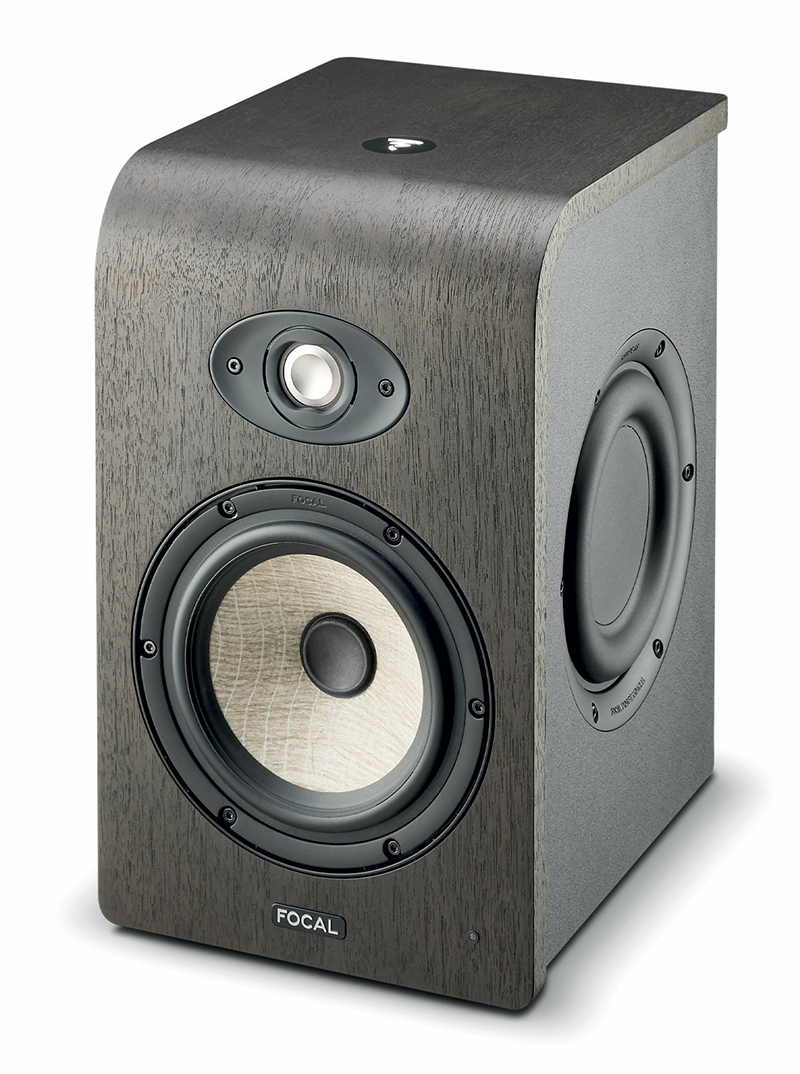
Focal Shape 65 Monitor Speaker The Focal Shape 65 is a 2-way speaker that at first glance seems to have a few more speakers than expected. Aside from the 6.5” flax membrane woofer and one-inch aluminum/magnesium m-shaped, inverted dome tweeter, each side of the speaker features a passive radiator. These are specially designed membranes that lack a coil and magnet (hence they are not technically “speakers”), but provide extended low frequency response in a more controlled manner than the passive, open ports you find on many other compact speakers. Given this unique design, the speakers must be placed in their upright position.
While talking about the obvious external details, we’ll point out the sharp looking walnut veneer that covers an MDF cabinet structure, and a set of adjustable feet enable you to adjust the front-facing angle of the speakers when placed on a desk or stand with more than an inch of incline. There are also mounting points for installing the speakers to stands or wall mounts.
A pair of internal Class AB amplifiers power the speakers to a maximum SPL of 109 dB, and the Shape 65 speakers present a generous frequency response (+/- 3dB) of 40 Hz – 35 kHz. There’s a power switch on the rear of the speaker, but after thirty minutes of inactivity, the speakers will enter a low-power sleep mode, to be awoken by detection of an incoming audio signal.
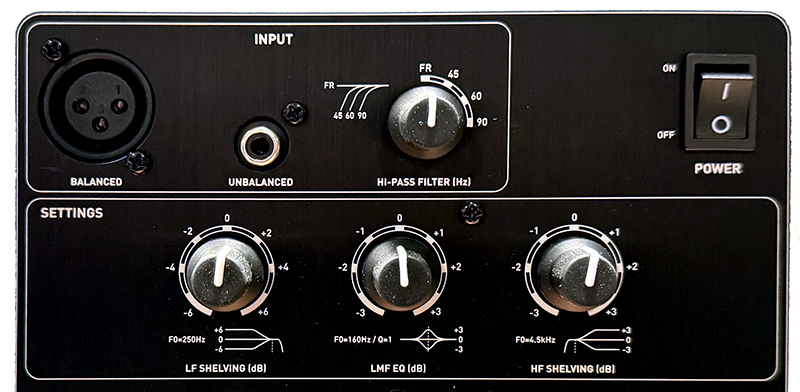
The rear of the speaker features both XLR and RCA inputs and an adjustable/bypassable high-pass crossover with multiple frequency points for use with a subwoofer (or you can run the speakers full-range). Some variable EQ controls enable boost/cut in low, mid, and high frequencies, but noticeably absent is a volume control. The speakers run full out, so you’ll need to control levels from your monitor switcher or audio interface output controls.
Focal Sub One Subwoofer
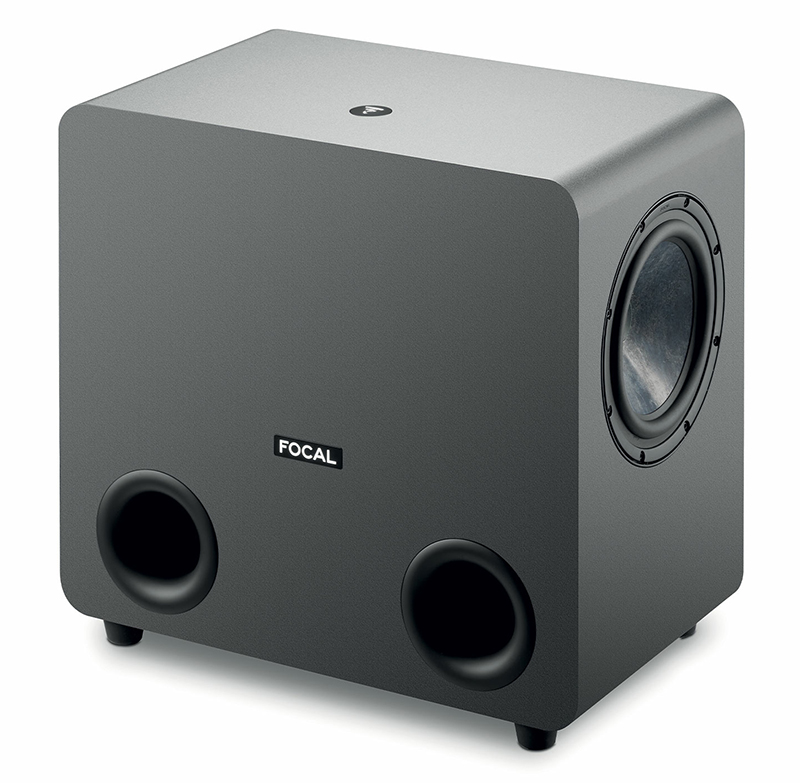 Compared with some of the more striking looking Focal speaker cabinets, the Focal Sub One subwoofer isn’t much to look at with its black MDF exterior, but you’re going to stick it underneath or behind your desk, so we appreciate the cost savings on tap by not wrapping this sub in cherry wood like the Focal Sub 12.
 The design of the Sub One is fabulous for project studios, as this class D 200W RMS long-excursion subwoofer has a narrow front-to-back profile, with front-facing ports and a pair of eight-inch slatefiber, double-skin woofers firing out to the sides. This design makes it possible to place the speaker close to a wall.
Slatefiber is a Focal proprietary material made from stacked layers of recycled carbon fiber and plastics. It is widely used throughout Focal’s speaker range.
The Sub One has a frequency range from 32 Hz to 120 Hz and peak 114dB SPL, providing more than enough low end whether mixing pop and rock, drop-tuned Scandinavian death metal, hip-hop, or that retro Gregorian chant record you’ve been hoping will make a fantastic comeback.
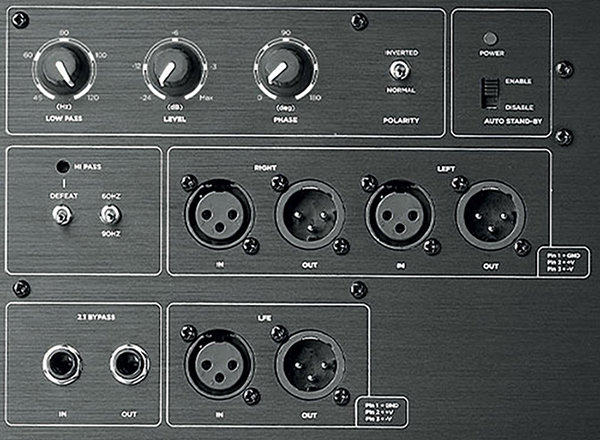
The rear of the Sub One has a plethora of controls including right and left inputs and outputs via XLR, continuously variable low-pass filter (45Hz – 120Hz), a level control, and a phase adjustment control for precise studio placement. It also has a hi-pass filter, switchable between 60Hz and 90Hz, which is bypassable.
Like the Shape 65 speakers, the Sub One has a sleep mode (auto stand-by), but you can bypass that for always-on operation (handy since the power switch is on the rear and not easy to reach once you set this up underneath or behind your mix desk). There’s also a set of LFE ins and outs on XLR for use in a multichannel mix configuration, and a quarter-inch TRS jack lets you connect any commonly available 2-position footswitch for instant subwoofer bypass.
Usability
Setup of the speakers was straightforward to start. In our studio, where our Zaor mix desk was already a bit tall, we placed the Focal Shape 65 speakers atop IsoAcoustics ISO-200 Studio Monitor Stands to achieve optimal height and physical decoupling from the desk. In order to fit solidly on the ISO-200 stands, we fully unscrewed/removed the speaker tilt legs since their rubber feet would have otherwise interfered with setting the speakers on the stands.Our desk has a long baffle across the floor for structural reinforcement, and the height would have blocked the Sub One, so we set the subwoofer atop a plywood crate behind the desk, centrally positioned, so that it would have unobstructed front and side output from the ports and speakers. Weighing just 40 pounds and with its narrow design (just 12.2” front to back, 20.5” wide, and 18.7” tall), physically positioning the Sub One was reasonably easy to accomplish without assistance.
We calibrated speaker output in our studio with the IK Multimedia ARC Studio room correction hardware, so setup consisted of running a pair of XLR cables from the ARC Studio output into the Sub One, and then a pair of XLR cables from the Sub One to each of the Shape 65 speakers on the desk. After connecting standard IEC power cables, the easy part was finished, and it was time to configure the speakers for our intended use, as an integrated, full-range monitor solution.
To use the speakers and sub as a full-range monitoring system, setting the crossovers was the most delicate, and confusing, part of the setup.
• Shape 65 high-pass options: Full range (40Hz), 45Hz, 60Hz, 90Hz
• Sub One low-pass settings: Continuous from 45Hz – 120Hz
• Sub One high-pass settings: Bypass, 60Hz, 90Hz
Some experimentation will come into play, because it’s possible to have some overlapping frequencies at the crossover, which could lead to an unintended boost of some frequencies that might color your mixes. If you have room correction like we do, then your correction curves may fix this for you, but it’s best to start with as little need for correction first.
Although the manual for the Shape 65 speakers suggests setting the hi-pass filter to 90Hz when used with a subwoofer, we found it more useful to set it for Full Range, bypassing the HPF completely, because the Sub One could take care of this in a more useful manner as explained below.
The Sub One’s selectable hi-pass filter controls what signals are passed along to your desktop speakers (the Shape 65s). We set the Sub One’s HPF to 90Hz, so only frequencies above that cut-off would pass into the monitors. We then set the low-pass filter to 90Hz. In this configuration, if we chose to bypass the sub, we’d hear the full-range sound from the Shape 65 monitors, while the 2.1 speaker setup (subwoofer engaged) would give us a full range sound from 32Hz – 35kHz.
Sound
If you’ve wanted to elevate your monitoring to pro studio quality levels, the Focal Shape 65 speakers and Sub One subwoofer deliver fabulous, rich, sound that should not disappoint. We’ve spent years avoiding subwoofers for fear of a smeared bottom end that would lack detail and cause our mixes not to translate well to other rooms, but this 2.1 speaker combination delivered the exact opposite of that.First, these speakers are loud! So loud, in fact, that we had to reduce the output level within our audio interface (Focusrite Red 8Line). The Shape 65 speakers have no level control, and it was suggested to us that in our configuration, the Sub One should be run with its volume at unity (full). We calibrated the speakers as a whole system with ARC Studio (check out this essential studio tool in review here). Because the Sub One’s low-pass filter is continuously variable, we knew that if we had a slight overlap and frequency bump, the ARC system would correct for that (plus our other minor room anomalies, of course).
The Focal sound can only be described as… open! Their extended high-frequency response goes well beyond most other speakers, but it does so without ever sounding harsh or shrill, which was our initial fear when reading about metallic tweeters with a 35kHz top end. In our 2.1 setup, the 6.5 woofers remained focused and punchy because we never tasked them with dropping below 90Hz, so there was no opportunity for very low frequencies to smear higher lows and mids.
Part of what can make subwoofers less precise for mixing is their size. Larger speakers have a longer throw, requiring a lot more power to move the cone, and the larger size speakers simply can’t respond to transients rapidly enough for precise monitoring. So the choice of two eight-inch woofers is great for this purpose. They’re small enough to provide precise response, but large enough to handle low frequencies.
This matched setup simply sounds like a three-way speaker setup, and never did we feel like sound was coming separately from our desktop speakers and separately from a subwoofer. We just had a big, beautiful, full range sound, and you simply couldn’t tell where the low end sound was coming from.
The Shape 65 speakers are non-fatiguing for extended listening, but be warned: they are revealing! We had multiple editors listen to a variety of source material across multiple genres and more than once, we noticed details in mixes that we simply never noticed before! The huge top end and great clarity through the mids made mixing on these speakers a dream. That clarity and open top end should also be commended as these speakers reveal mix subtleties like the details of your delays and reverb tails.
We appreciated the generous sweet spot for listening. Although height of the tweeters had a noticeable impact on the sound when sitting in the mix triangle, we found that for other people listening to your mix, or just sitting in the room listening to music, these speakers delivered a huge, loud, clear sound that was more useful than many other speakers that only sound good when planted at the desk. In a project studio where you probably don’t have a separate, large set of mains for group review of a mix, these speakers worked remarkably well enabling everyone involved to accurately hear the mix.
Using a commonly available BOSS FS-5 footswitch, we could bypass the Sub One, and hear the entire mix run through just the Shape 65 speakers. In our well-sized mix room (roughly 15’ x 18’), we still heard a precisely defined, punchy mix, but without the extended low-frequency content, and without the overall presence of sound that the powerful Sub One added. Using the Shape 65 speakers on their own is a great starting point if you’re looking to upgrade from less-costly speakers to studio-worthy alternatives, but our main goal here was to find a solution that delivered a complete mix picture in a reasonably sized room without having to spend a fortune. This 2.1 speaker combination delivered that without breaking a sweat.
If you already have a set of near-field monitors that you’re happy with, you can easily incorporate the Sub One into your setup, but taken together, this is a beautiful sounding speaker setup that is priced within reach of the semi-professional project studio.
Documentation and Product Support
Focal provides reasonable documentation with their speaker products, but we found that they could use some additional details and setup tips for the integration of their products.Focal speakers in North America have a five years (driver) and two years (electronic), non-transferable, warranty.
Price
• The Shape 65 6.5-inch powered studio monitor sells for $899 (each).• The Sub One 8-inch powered studio subwoofer sells for $1,199.
For just under $3,000, this 2.1 speaker combination is a fantastic value, delivering big studio monitoring sound in a compact package that any semi-professional project studio should be able to accommodate.
Contact Information
Focalwww.focal.com